Using Grub2 and LUA installed on USB booting ISO images
Create a bootable USB drive with GRUB2 and LUA to auto-detect and boot multiple Linux live ISO images
https://linux-old.xvx.cz/2010/03/using-grub2-and-lua-installed-on-usb-booting-iso-images-2/
I got 16 GB USB flash from my brother, because he can’t see me still using my old 64 MB. He decided to buy Imation Nano Flash Drive.
Because many of my friends and colleagues are using Windows, I use NTFS on it. Old FAT is not “usable” in these days, because it can’t handle bigger files.
From the first time I used USB disks I always wanted to have a bootable disk/flash with live CDs - so here are a few notes on how to create a USB flash drive able to boot stored live CDs:
First you need to compile grub2 yourself, because default grub2 installations in distributions do not have LUA support:
1
aptitude install autogen automake bison flex gettext gcc autoconf ruby bzr libfreetype6-dev
Debian way compilation and installation:
1
2
3
4
5
6
7
8
9
10
11
12
13
aptitude install dpkg-dev fakeroot
apt-get source grub2
apt-get build-dep grub2
dpkg-source -x grub2_1.98-1.dsc

bzr branch http://bzr.savannah.gnu.org/r/grub-extras/lua ./grub2-1.98/debian/grub-extras/lua

(
  cd grub2-1.98 || exit
  dpkg-buildpackage -rfakeroot -b
)
dpkg -r grub-pc grub-common
dpkg -i ./grub-common_1.98-1_amd64.deb ./grub-pc_1.98-1_amd64.deb
Compilation and installation from source code (not necessary if you follow “Debian steps” above):
1
2
3
4
5
6
7
8
9
10
11
12
13
bzr branch http://bzr.savannah.gnu.org/r/grub/trunk/grub
mkdir ./grub/grub-extras
bzr branch http://bzr.savannah.gnu.org/r/grub-extras/lua ./grub/grub-extras/lua
#bzr branch http://bzr.savannah.gnu.org/r/grub-extras/gpxe ./grub/grub-extras/gpxe

(
  cd grub || exit
  export GRUB_CONTRIB=./grub-extras/
  ./autogen.sh
  ./configure --prefix=/tmp/grub
  make
  make install
)
Mount USB to some directory (in my case /mnt/sdb1) and install grub with Lua support on it:
1
2
mount /dev/sdb1 /mnt/sdb1
grub-install --root-directory=/mnt/sdb1 /dev/sdb
To make grub nicer, I add wallpaper and fonts to it:
1
2
3
wget --directory-prefix=/tmp/ http://unifoundry.com/unifont-5.1.20080820.pcf.gz
grub-mkfont --output=/mnt/sdb1/boot/grub/unifont.pf2 --range=0x0000-0x0241,0x2190-0x21FF,0x2500-0x259f /tmp/unifont-5.1.20080820.pcf.gz -v -b
wget http://ubuntulife.files.wordpress.com/2007/05/linux.jpg /mnt/sdb1/boot/grub/
Last step is creating right configuration and downloading live iso images of various Linux distributions:
Let’s download the ISOs first. It’s better to use most actual ones. These are working fine for me:
1
2
3
4
5
6
7
8
mkdir -v /mnt/sdb1/isos
wget -c --directory-prefix=/mnt/sdb1/isos \
  http://ftp.heanet.ie/pub/linuxmint.com/testing/LinuxMint-8-x64-RC1.iso \
  http://gd.tuwien.ac.at/opsys/linux/grml/grml64_2009.10.iso \
  http://ftp.cc.uoc.gr/mirrors/linux/slax/SLAX-6.x/slax-6.1.2.iso \
  http://downloads.sourceforge.net/project/systemrescuecd/sysresccd-x86/1.5.0/systemrescuecd-x86-1.5.0.iso \
  http://releases.ubuntu.com/karmic/ubuntu-9.10-desktop-amd64.iso \
  http://xpud.googlecode.com/files/xpud-0.9.2.iso
The following code is taken from Ubuntu Forums where I added more live CDs. I also changed the main grub.cfg a little bit and use 64 live CDs amd64.
Save following text as 3 files:
/mnt/sdb1/boot/grub/grub.cfg:1 2 3 4 5 6 7 8 9 10 11 12 13 14 15 16 17 18 19 20 21 22 23 24 25 26 27 28 29 30 31 32 33 34
insmod vbeinfo insmod font if loadfont /boot/grub/unifont.pf2; then set gfxmode="1024x768x32,800x600x32,640x480x32,1024x768,800x600,640x480" # set gfxpayload=keep insmod gfxterm # insmod vbe if terminal_output gfxterm; then true ; else terminal gfxterm fi fi insmod jpeg if background_image /boot/grub/linux.jpg; then set menu_color_normal=black/black set color_highlight=red/blue else set menu_color_normal=cyan/blue set menu_color_highlight=white/blue fi set default=0 set timeout=10 # Uncomment for a different ISO files search path #set isofolder="/boot/isos" #export isofolder # Uncomment for a different live system language #set isolangcode="us" #export isolangcode source /boot/grub/listisos.lua
/mnt/sdb1/boot/grub/bootiso.lua:1 2 3 4 5 6 7 8 9 10 11 12 13 14 15 16 17 18 19 20 21 22 23 24 25 26 27 28 29 30 31 32 33 34 35 36 37 38 39 40 41 42 43 44 45 46 47 48 49 50 51 52 53 54 55 56 57 58 59 60 61 62 63 64 65 66 67 68 69 70 71 72 73 74 75 76 77 78 79 80 81 82 83 84 85 86 87 88 89 90 91 92 93 94 95 96 97 98 99 100 101 102 103 104 105 106 107 108 109 110 111 112 113 114 115 116 117 118 119 120 121 122 123 124 125 126 127 128 129 130 131 132 133 134 135 136 137 138 139 140 141 142 143 144 145 146 147 148 149
#!lua -- Detects the live system type and boots it function boot_iso (isofile, langcode) -- grml if (dir_exist ("(loop)/boot/grml64")) then boot_linux ( "(loop)/boot/grml64/linux26", "(loop)/boot/grml64/initrd.gz", "findiso=" .. isofile .. " apm=power-off quiet boot=live nomce" ) -- Parted Magic elseif (dir_exist ("(loop)/pmagic")) then boot_linux ( "(loop)/pmagic/bzImage", "(loop)/pmagic/initramfs", "iso_filename=" .. isofile .. " edd=off noapic load_ramdisk=1 prompt_ramdisk=0 rw" .. " sleep=10 loglevel=0 keymap=" .. langcode ) -- Sidux elseif (dir_exist ("(loop)/sidux")) then boot_linux ( find_file ("(loop)/boot", "vmlinuz%-.*%-sidux%-.*"), find_file ("(loop)/boot", "initrd%.img%-.*%-sidux%-.*"), "fromiso=" .. isofile .. " boot=fll quiet" ) -- Slax elseif (dir_exist ("(loop)/slax")) then boot_linux ( "(loop)/boot/vmlinuz", "(loop)/boot/initrd.gz", "from=" .. isofile .. " ramdisk_size=6666 root=/dev/ram0 rw" ) -- SystemRescueCd elseif (grub.file_exist ("(loop)/isolinux/rescue64")) then boot_linux ( "(loop)/isolinux/rescue64", "(loop)/isolinux/initram.igz", "isoloop=" .. isofile .. " docache rootpass=xxxx setkmap=" .. langcode ) -- Tinycore elseif (grub.file_exist ("(loop)/boot/tinycore.gz")) then boot_linux ( "(loop)/boot/bzImage", "(loop)/boot/tinycore.gz" ) -- Ubuntu and Casper based Distros elseif (dir_exist ("(loop)/casper")) then boot_linux ( "(loop)/casper/vmlinuz", find_file ("(loop)/casper", "initrd%..z"), "boot=casper iso-scan/filename=" .. isofile .. " quiet splash noprompt" .. " keyb=" .. langcode .. " debian-installer/language=" .. langcode .. " console-setup/layoutcode?=" .. langcode .. " --" ) -- Xpud elseif (grub.file_exist ("(loop)/boot/xpud")) then boot_linux ( "(loop)/boot/xpud", "(loop)/opt/media" ) else print_error ("Unsupported ISO type") end end -- Help function to show an error function print_error (msg) print ("Error: " .. msg) grub.run ("read") end -- Help function to search for a file function find_file (folder, match) local filename local function enum_file (name) if (filename == nil) then filename = string.match (name, match) end end grub.enum_file (enum_file, folder) if (filename) then return folder .. "/" .. filename else return nil end end -- Help function to check if a directory exist function dir_exist (dir) return (grub.run("test -d '" .. dir .. "'") == 0) end -- Boots a Linux live system function boot_linux (linux, initrd, params) if (linux and grub.file_exist (linux)) then if (initrd and grub.file_exist (initrd)) then if (params) then grub.run ("linux " .. linux .. " " .. params) else grub.run ("linux " .. linux) end grub.run ("initrd " .. initrd) else print_error ("Booting Linux failed: cannot find initrd file '" .. initrd .. "'") end else print_error ("Booting Linux failed: cannot find linux file '" .. initrd .. "'") end end -- Mounts the iso file function mount_iso (isofile) local result = false if (isofile == nil) then print_error ("variable 'isofile' is undefined") elseif (not grub.file_exist (isofile)) then print_error ("Cannot find isofile '" .. isofile .. "'") else local err_no, err_msg = grub.run ("loopback loop " .. isofile) if (err_no ~= 0) then print_error ("Cannot load ISO: " .. err_msg) else result = true end end return result end -- Getting the environment parameters isofile = grub.getenv ("isofile") langcode = grub.getenv ("isolangcode") if (langcode == nil) then langcode = "us" end -- Mounting and booting the live system if (mount_iso (isofile)) then boot_iso (isofile, langcode) end
/mnt/sdb1/boot/grub/listisos.lua:1 2 3 4 5 6 7 8 9 10 11 12 13 14 15 16 17 18 19
#!lua isofolder = grub.getenv ("isofolder") if (isofolder == nil) then isofolder = "/isos" end function enum_file (name) local title = string.match (name, "(.*)%.[iI][sS][oO]") if (title) then local source = "set isofile=" .. isofolder .. "/" .. name .. "\nsource /boot/grub/bootiso.lua" grub.add_menu (source, title) end end grub.enum_file (enum_file, isofolder)
UPDATE: In the new grub versions I had to modify following lines (from source -> lua and one module name vbeinfo -> vbe) otherwise it was not running correctly. Please look at these lines and change it in the scripts above:
1
2
3
4
5
insmod vbe

lua /boot/grub/listisos.lua

      "\nlua /boot/grub/bootiso.lua"
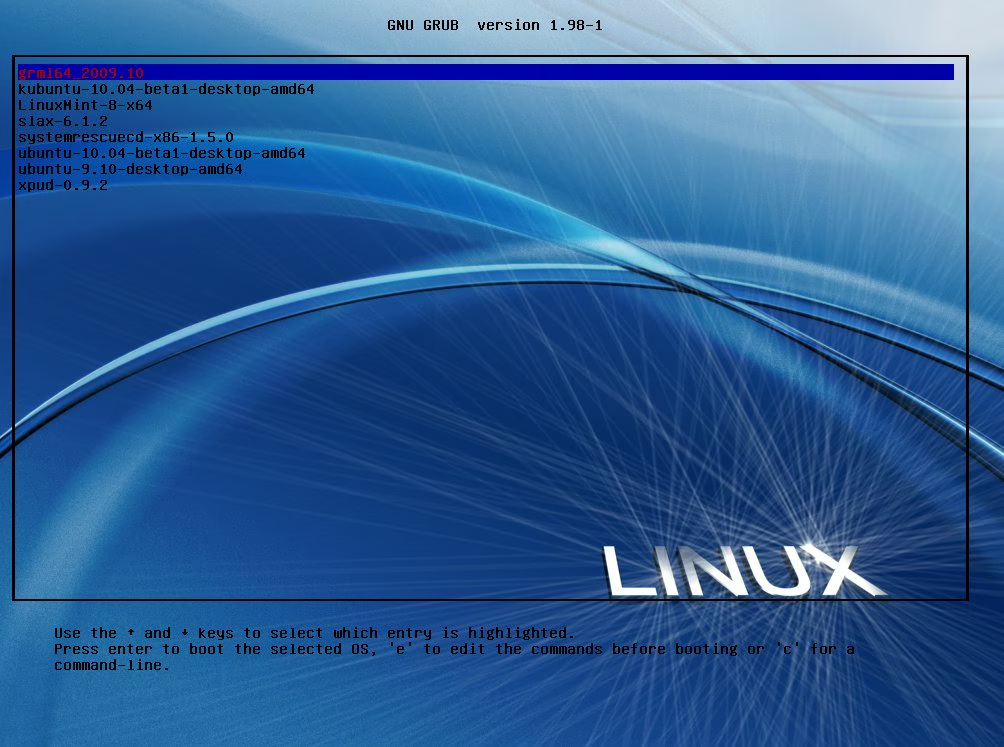
After unmounting your USB flash should be bootable and you should get menu similar to this one:
Enjoy :-)