Slack bot for answering questions from Confluence using Amazon Bedrock
Slack bot that answers questions from your Confluence wiki using Amazon Bedrock Knowledge Base, OpenSearch Serverless, and LiteLLM on Amazon EKS, with Arize Phoenix tracing, provisioned with OpenTofu.
This post builds directly on top of Amazon EKS with Open WebUI and AWS Bedrock managed by OpenTofu, which provisions an Amazon EKS cluster with LiteLLM (an OpenAI-compatible proxy in front of AWS Bedrock), Envoy Gateway, cert-manager, ExternalDNS and Karpenter - all driven by OpenTofu. That cluster is the foundation here; this post adds a Retrieval-Augmented Generation (RAG) pipeline on top of it.
The goal is a Slack bot that answers from your own Confluence wiki. An Amazon Bedrock Knowledge Base crawls a single Confluence space, embeds the pages with Amazon Titan and stores the vectors in Amazon OpenSearch Serverless. LiteLLM then retrieves the relevant chunks on every question and feeds them to a Bedrock model, while Collmbo - a small Slack bot - is the chat front-end. Collmbo sends a plain chat request and all the RAG wiring lives in LiteLLM and AWS.
The setup should align with the following criteria:
- An Amazon Bedrock Knowledge Base indexes one configurable Confluence space (the space key is an OpenTofu variable)
- Confluence credentials are rendered by OpenTofu into an AWS Secrets Manager secret - the only credential store the Bedrock connector accepts
- Amazon OpenSearch Serverless is the vector store backing the Knowledge Base (the only store the Confluence connector supports)
- LiteLLM performs RAG server-side through an always-on vector store attached to a model - the bot passes no extra parameters
- Collmbo runs as a single container (
ghcr.io/iwamot/collmbo) deployed by OpenTofu into the existing EKS cluster - Collmbo talks to a dedicated LiteLLM release inside the cluster through the OpenAI-compatible API (
http://litellm-kb.litellm-kb.svc:4000/v1) - no model credentials in the bot - Slack connectivity uses Socket Mode, so the bot needs no public endpoint and no inbound load balancer
- Arize Phoenix (OSS) receives OpenTelemetry traces from the
litellm-kbproxy
Architecture
flowchart TD
  User(["fa:fa-user Slack User"])
  Slack["fa:fa-slack Slack"]
  Confluence["fa:fa-confluence Confluence Cloud"]

  User -- "message / @mention" --> Slack
  Slack <== "Socket Mode (outbound WebSocket)" ==> CO
  CO -- "OpenAI API" --> LL
  LL -- "Retrieve" --> KB
  KB -- "vectors" --> AOSS
  LL -- "Converse (+context)\nSigV4" --> BR
  BR --> GR
  LL -. "OTLP traces" .-> PHX
  KB -. "crawl + embed (ingestion job)" .-> Confluence

  subgraph AWS["fa:fa-cloud AWS us-east-1"]
    BR["fa:fa-brain Amazon Bedrock"]
    GR["fa:fa-lock Bedrock Guardrail"]
    KB["fa:fa-book Bedrock Knowledge Base"]
    AOSS["fa:fa-database OpenSearch Serverless"]
    SM["fa:fa-key Secrets Manager\n(Confluence creds)"]
    subgraph EKS["fa:fa-dharmachakra Amazon EKS"]
      CO["fa:fa-robot Collmbo"]
      LL["fa:fa-server LiteLLM (litellm-kb)"]
      PHX["fa:fa-chart-line Arize Phoenix"]
    end
  end

  KB -. "reads creds" .-> SM

  style User fill:whitesmoke,stroke:dimgray,color:black
  style Slack fill:rebeccapurple,stroke:deepskyblue,color:white
  style Confluence fill:royalblue,stroke:turquoise,color:white
  style BR fill:orange,stroke:white,color:darkslategray
  style GR fill:orange,stroke:white,color:darkslategray
  style KB fill:orange,stroke:white,color:darkslategray
  style AOSS fill:orange,stroke:white,color:darkslategray
  style SM fill:orange,stroke:white,color:darkslategray
  style EKS fill:royalblue,stroke:white,color:white
  style CO fill:royalblue,stroke:white,color:white
  style LL fill:royalblue,stroke:white,color:white
  style PHX fill:indigo,stroke:white,color:white
The request flow:
- A user sends a message in Slack (direct message or
@mentionin a channel). - Slack delivers the event to Collmbo over the existing Socket Mode WebSocket.
- Collmbo builds an OpenAI-format chat request and sends it to the in-cluster
litellm-kbservice (http://litellm-kb.litellm-kb.svc:4000/v1), selecting the knowledge-base-attached model (...-kb). - Because that model has a vector store attached, LiteLLM calls the Bedrock Knowledge Base
RetrieveAPI, which searches the Confluence vectors in OpenSearch Serverless and returns the most relevant chunks. - LiteLLM prepends the retrieved chunks to the conversation and calls Amazon Bedrock with SigV4 (via EKS Pod Identity), applying the Bedrock Guardrail configured in the base post.
- The grounded answer travels back through LiteLLM to Collmbo, which posts it to the Slack thread.
Separately, on a schedule (or on demand), the Knowledge Base ingestion job crawls the configured Confluence space, chunks and embeds every page with Titan, and writes the vectors into OpenSearch Serverless - this is what populates the store the Retrieve step reads.
Requirements
This post assumes the cluster from Amazon EKS with Open WebUI and AWS Bedrock managed by OpenTofu is already described - the same OpenTofu working directory (${TMP_DIR}/${CLUSTER_FQDN}), S3 backend, providers (helm, kubectl) and the litellm release are reused. You will need the AWS CLI configured exactly as in that post:
1
2
3
4
# AWS Credentials
export AWS_ACCESS_KEY_ID="xxxxxxxxxxxxxxxxxx"
export AWS_SECRET_ACCESS_KEY="xxxxxxxxxxxxxxxxxxxxxxxxxxxxxxxxxxxxxx"
export AWS_SESSION_TOKEN="xxxxxxxx"
The environment variables (AWS_REGION, CLUSTER_FQDN, TMP_DIR, TF_VAR_cluster_fqdn, TF_VAR_tags, the Google OIDC variables, …) are the same ones exported in the base post and are not repeated here.
The Amazon Titan Text Embeddings V2 model must be enabled in the Bedrock console for the target region (one-time, per account) - the Knowledge Base uses it to embed Confluence pages.
You also need a Confluence Cloud site (a free *.atlassian.net instance works), at least one space with a few pages, and an Atlassian API token for basic authentication. Map them - together with the “space key” to index - to the TF_VAR_* names the OpenTofu code expects (in CI these come from secrets):
1
2
3
4
export TF_VAR_confluence_url="${MY_CONFLUENCE_URL:-https://mylabsdev.atlassian.net}"
export TF_VAR_confluence_username="${MY_CONFLUENCE_EMAIL:-petr.ruzicka@gmail.com}"
export TF_VAR_confluence_api_token="${MY_CONFLUENCE_API_TOKEN:-${MY_ATLASSIAN_PERSONAL_TOKEN:-confluence-api-token-placeholder}}"
export TF_VAR_confluence_space_key="${MY_CONFLUENCE_SPACE_KEY:-myspace}"
Install the required tools:
1
mise use opentofu@1.12.1 aws@2.35.2 kubectl@1.36.1
Create a Slack App
Creating the app, installing it to a workspace, and copying the Bot User OAuth Token (xoxb-...) are the same steps described in Amazon Bedrock AgentCore Slack Bot deployed with OpenTofu under Create a Slack App - follow that section, with two Collmbo-specific differences:
- Use a manifest When creating the app, choose From an app manifest (instead of From scratch) and paste Collmbo’s
manifest.yml. It already enables Socket Mode and sets the required bot scopes. - Generate an App-Level Token Socket Mode needs an extra token: go to Settings > Basic Information > App-Level Tokens, choose Generate Token and Scopes, add the
connections:writescope, and copy the App-Level Token (xapp-1-...).
Slack permissions and events
The manifest is the source of truth for the bot’s permissions, so creating the app From an app manifest is strongly recommended. Collmbo’s manifest.yml sets exactly the following.
Bot token scopes (oauth_config.scopes.bot):
| Scope | Why Collmbo needs it |
|---|---|
channels:history | Read messages in public channels it is invited to |
groups:history | Read messages in private channels |
im:history | Read direct messages |
mpim:history | Read group direct messages |
im:write | Open direct-message conversations |
chat:write | Post replies |
chat:write.public | Post in public channels without being a member |
files:read | Read uploaded images / PDFs for multimodal input |
files:write | Upload files back to Slack |
users:read | Look up the sender’s locale (the set_locale middleware) |
Subscribed bot events (settings.event_subscriptions.bot_events):
app_home_openedmessage.channelsmessage.groupsmessage.immessage.mpim
Map secrets to the TF_VAR_* names Collmbo’s OpenTofu code expects:
1
2
export TF_VAR_slack_app_token="${MY_SLACK_APP_TOKEN:-xapp-placeholder}"
export TF_VAR_slack_bot_token="${MY_SLACK_BOT_TOKEN:-xoxb-placeholder}"
OpenTofu Code
All resources below are added to the same OpenTofu working directory used by the base post (${TMP_DIR}/${CLUSTER_FQDN}), so they share its state and providers and can reference its resources directly (the EKS module, the Bedrock guardrail aws_bedrock_guardrail.ai_safety, and the cluster add-ons).

Knowledge Base and Collmbo variables
Add the Slack token variables plus the Confluence connection variables. They are all populated from the TF_VAR_* environment variables exported above:
1
2
3
4
5
6
7
8
9
10
11
12
13
14
15
16
17
18
19
20
21
22
23
24
25
26
27
28
29
30
31
32
33
34
tee "${TMP_DIR}/${CLUSTER_FQDN}/collmbo-variables.tf" << \EOF
variable "slack_app_token" {
  description = "Slack App-Level Token (xapp-1-...) used for Socket Mode"
  type        = string
  sensitive   = true
}

variable "slack_bot_token" {
  description = "Slack Bot User OAuth Token (xoxb-...)"
  type        = string
  sensitive   = true
}

variable "confluence_url" {
  description = "Confluence Cloud base URL (must end in .atlassian.net)"
  type        = string
}

variable "confluence_username" {
  description = "Atlassian account email used for basic authentication"
  type        = string
}

variable "confluence_api_token" {
  description = "Atlassian API token used in place of the password"
  type        = string
  sensitive   = true
}

variable "confluence_space_key" {
  description = "Key of the single Confluence space to index (e.g. DOCS)"
  type        = string
}
EOF
Confluence credentials in Secrets Manager
The Bedrock Confluence connector reads its credentials only from AWS Secrets Manager (Parameter Store is not accepted). For basic authentication the secret must contain username (the account email), password (the API token) and hostUrl. OpenTofu renders it from the variables above:
1
2
3
4
5
6
7
8
9
10
11
12
13
14
15
16
tee "${TMP_DIR}/${CLUSTER_FQDN}/kb-confluence-secret.tf" << \EOF
resource "aws_secretsmanager_secret" "confluence" {
  name                    = "${local.cluster_name}-confluence"
  description             = "Confluence basic-auth credentials for the Bedrock Knowledge Base"
  recovery_window_in_days = 0
}

resource "aws_secretsmanager_secret_version" "confluence" {
  secret_id = aws_secretsmanager_secret.confluence.id
  secret_string = jsonencode({
    username = var.confluence_username
    password = var.confluence_api_token
    hostUrl  = var.confluence_url
  })
}
EOF
OpenSearch Serverless vector store
The Confluence connector is only supported with an Amazon OpenSearch Serverless vector store (S3 Vectors is not accepted for managed connectors), so the Knowledge Base stores its embeddings in an OpenSearch Serverless collection of type VECTORSEARCH.

The collection needs three policies before it can be created or used: an encryption policy (required before creation), a network policy, and a data access policy granting both the OpenTofu caller (to create the index) and the Knowledge Base role (to read/write vectors):
1
2
3
4
5
6
7
8
9
10
11
12
13
14
15
16
17
18
19
20
21
22
23
24
25
26
27
28
29
30
31
32
33
34
35
36
37
38
39
40
41
42
43
44
45
46
47
48
49
50
51
52
53
54
55
56
57
58
59
60
61
62
tee "${TMP_DIR}/${CLUSTER_FQDN}/kb-opensearch.tf" << \EOF
locals {
  aoss_collection_name = "${local.cluster_name}-confluence"
  # Field names / dimensions shared by the index and the Knowledge Base mapping.
  aoss_index_name       = "bedrock-knowledge-base-index"
  aoss_vector_field     = "bedrock-knowledge-base-vector"
  aoss_text_field       = "AMAZON_BEDROCK_TEXT_CHUNK"
  aoss_metadata_field   = "AMAZON_BEDROCK_METADATA"
  aoss_vector_dimension = 1024
  # Convert assumed-role STS ARN to IAM role ARN for the AOSS principal:
  # arn:aws:sts::<acct>:assumed-role/<role>/<session>
  # -> arn:aws:iam::<acct>:role/<role>. Roles with paths (for example
  # AWSReservedSSO_*) may need a manual principal.
  aoss_caller_arn = replace(
    replace(data.aws_caller_identity.current.arn, "/:sts::(\\d+):assumed-role/([^/]+)/.*/", ":iam::$1:role/$2"),
    "/^(arn:aws:iam::\\d+:role/[^/]+)/.*/", "$1"
  )
}

resource "aws_opensearchserverless_security_policy" "encryption" {
  name = local.aoss_collection_name
  type = "encryption"
  policy = jsonencode({
    Rules       = [{ Resource = ["collection/${local.aoss_collection_name}"], ResourceType = "collection" }]
    AWSOwnedKey = true
  })
}

resource "aws_opensearchserverless_security_policy" "network" {
  name = local.aoss_collection_name
  type = "network"
  policy = jsonencode([{
    Rules = [
      { Resource = ["collection/${local.aoss_collection_name}"], ResourceType = "collection" },
      { Resource = ["collection/${local.aoss_collection_name}"], ResourceType = "dashboard" },
    ]
    AllowFromPublic = true
  }])
}

resource "aws_opensearchserverless_collection" "confluence" {
  name             = local.aoss_collection_name
  type             = "VECTORSEARCH"
  standby_replicas = "DISABLED"
  depends_on       = [aws_opensearchserverless_security_policy.encryption]
}

resource "aws_opensearchserverless_access_policy" "data" {
  name = local.aoss_collection_name
  type = "data"
  policy = jsonencode([{
    Rules = [
      { Resource = ["collection/${local.aoss_collection_name}"], Permission = ["aoss:*"], ResourceType = "collection" },
      { Resource = ["index/${local.aoss_collection_name}/*"], Permission = ["aoss:*"], ResourceType = "index" },
    ]
    Principal = [
      local.aoss_caller_arn,
      aws_iam_role.bedrock_kb.arn,
    ]
  }])
}
EOF
OpenSearch index (created out of band)
Bedrock expects the vector index to already exist in the collection, but there is no Terraform, CloudFormation or CDK resource that creates an OpenSearch Serverless index - only the AWS CLI can.

A terraform_data resource runs aws opensearchserverless create-index with the kNN schema and is re-run whenever the collection is replaced:
1
2
3
4
5
6
7
8
9
10
11
12
13
14
15
16
17
18
19
20
21
22
23
24
25
26
27
28
29
30
31
32
33
34
35
36
37
38
39
40
41
42
43
44
45
46
47
48
tee "${TMP_DIR}/${CLUSTER_FQDN}/kb-index.tf" << \EOF
locals {
  aoss_index_schema = jsonencode({
    settings = { index = { knn = true } }
    mappings = {
      properties = {
        (local.aoss_vector_field) = {
          type      = "knn_vector"
          dimension = local.aoss_vector_dimension
          method    = { name = "hnsw", engine = "faiss", space_type = "l2" }
        }
        (local.aoss_text_field)     = { type = "text" }
        (local.aoss_metadata_field) = { type = "text", index = false }
      }
    }
  })
}

resource "terraform_data" "aoss_index" {
  triggers_replace = [aws_opensearchserverless_collection.confluence.id]

  provisioner "local-exec" {
    interpreter = ["/bin/bash", "-c"]
    command     = <<-CMD
      set -euo pipefail
      ID=${aws_opensearchserverless_collection.confluence.id}
      NAME=${local.aoss_index_name}
      # Retry create-index (the data access policy is eventually consistent) and
      # consider it done once get-index can read it back. This covers propagation
      # delay, an already-existing index, and the index becoming queryable.
      for i in $(seq 1 20); do
        aws opensearchserverless create-index --id "$ID" --index-name "$NAME" \
          --index-schema ${jsonencode(local.aoss_index_schema)} 2> /dev/null || true
        if aws opensearchserverless get-index --id "$ID" --index-name "$NAME" > /dev/null 2>&1; then
          echo "index ready"
          exit 0
        fi
        echo "waiting for index (attempt $i)..."
        sleep 15
      done
      echo "index did not become ready in time" >&2
      exit 1
    CMD
  }

  depends_on = [aws_opensearchserverless_access_policy.data]
}
EOF
Bedrock Knowledge Base and Confluence data source
The Knowledge Base ties everything together: an IAM role Bedrock assumes (with permission to read the Secrets Manager secret, embed with Titan, and access the OpenSearch collection), the vector configuration, and a Confluence data source restricted to the single space via a Space inclusion filter on the space key:
1
2
3
4
5
6
7
8
9
10
11
12
13
14
15
16
17
18
19
20
21
22
23
24
25
26
27
28
29
30
31
32
33
34
35
36
37
38
39
40
41
42
43
44
45
46
47
48
49
50
51
52
53
54
55
56
57
58
59
60
61
62
63
64
65
66
67
68
69
70
71
72
73
74
75
76
77
78
79
80
81
82
83
84
85
86
87
88
89
90
91
92
93
94
95
96
97
98
99
100
101
102
103
104
105
106
107
108
109
110
111
112
113
114
115
116
117
118
119
120
121
122
123
124
125
126
127
128
129
130
131
132
tee "${TMP_DIR}/${CLUSTER_FQDN}/kb.tf" << \EOF
data "aws_iam_policy_document" "bedrock_kb_assume" {
  statement {
    actions = ["sts:AssumeRole"]
    principals {
      type        = "Service"
      identifiers = ["bedrock.amazonaws.com"]
    }
    condition {
      test     = "StringEquals"
      variable = "aws:SourceAccount"
      values   = [data.aws_caller_identity.current.account_id]
    }
  }
}

data "aws_iam_policy_document" "bedrock_kb" {
  statement {
    sid       = "ReadConfluenceSecret"
    actions   = ["secretsmanager:GetSecretValue"]
    resources = [aws_secretsmanager_secret.confluence.arn]
  }
  statement {
    sid       = "InvokeEmbeddingModel"
    actions   = ["bedrock:InvokeModel"]
    resources = ["arn:aws:bedrock:*::foundation-model/amazon.titan-embed-text-v2:0"]
  }
  statement {
    sid       = "AccessOpenSearch"
    actions   = ["aoss:APIAccessAll"]
    resources = [aws_opensearchserverless_collection.confluence.arn]
  }
}

resource "aws_iam_role" "bedrock_kb" {
  name               = "${local.cluster_name}-bedrock-kb"
  assume_role_policy = data.aws_iam_policy_document.bedrock_kb_assume.json
}

resource "aws_iam_role_policy" "bedrock_kb" {
  name   = "bedrock-kb"
  role   = aws_iam_role.bedrock_kb.id
  policy = data.aws_iam_policy_document.bedrock_kb.json
}

resource "aws_bedrockagent_knowledge_base" "confluence" {
  name     = "${local.cluster_name}-confluence"
  role_arn = aws_iam_role.bedrock_kb.arn

  knowledge_base_configuration {
    type = "VECTOR"
    vector_knowledge_base_configuration {
      embedding_model_arn = "arn:aws:bedrock:${data.aws_region.current.region}::foundation-model/amazon.titan-embed-text-v2:0"
    }
  }

  storage_configuration {
    type = "OPENSEARCH_SERVERLESS"
    opensearch_serverless_configuration {
      collection_arn    = aws_opensearchserverless_collection.confluence.arn
      vector_index_name = local.aoss_index_name
      field_mapping {
        vector_field   = local.aoss_vector_field
        text_field     = local.aoss_text_field
        metadata_field = local.aoss_metadata_field
      }
    }
  }

  depends_on = [terraform_data.aoss_index]
}

resource "aws_bedrockagent_data_source" "confluence" {
  name              = "confluence-${var.confluence_space_key}"
  knowledge_base_id = aws_bedrockagent_knowledge_base.confluence.id
  # RETAIN avoids Bedrock DELETE_UNSUCCESSFUL during `tofu destroy`: collection
  # teardown removes vectors anyway, so explicit per-vector purge is unnecessary.
  data_deletion_policy = "RETAIN"

  data_source_configuration {
    type = "CONFLUENCE"
    confluence_configuration {
      source_configuration {
        host_url               = var.confluence_url
        host_type              = "SAAS"
        auth_type              = "BASIC"
        credentials_secret_arn = aws_secretsmanager_secret.confluence.arn
      }
      crawler_configuration {
        filter_configuration {
          type = "PATTERN"
          pattern_object_filter {
            filters {
              object_type       = "Space"
              inclusion_filters = ["^${var.confluence_space_key}$"]
            }
          }
        }
      }
    }
  }
}

# Start a Bedrock ingestion job when the data source is created/replaced.
# Terraform has no StartIngestionJob resource, so terraform_data runs the AWS CLI.
resource "terraform_data" "confluence_ingestion" {
  triggers_replace = [aws_bedrockagent_data_source.confluence.data_source_id]

  provisioner "local-exec" {
    interpreter = ["/bin/bash", "-c"]
    command     = <<-CMD
      set -euo pipefail
      aws bedrock-agent start-ingestion-job \
        --knowledge-base-id ${aws_bedrockagent_knowledge_base.confluence.id} \
        --data-source-id ${aws_bedrockagent_data_source.confluence.data_source_id} \
        --query 'ingestionJob.{id:ingestionJobId,status:status}'
    CMD
  }

  depends_on = [aws_bedrockagent_data_source.confluence]
}

output "knowledge_base_id" {
  description = "Bedrock Knowledge Base ID"
  value       = aws_bedrockagent_knowledge_base.confluence.id
}

output "data_source_id" {
  description = "Confluence data source ID"
  value       = aws_bedrockagent_data_source.confluence.data_source_id
}
EOF
Arize Phoenix
Arize Phoenix is an open-source LLM tracing and evaluation platform. It is installed with its Helm chart and receives OpenTelemetry traces from the litellm-kb proxy, so the retrieval and the Bedrock call are each captured as spans that can be inspected in the UI.

1
2
3
4
5
6
7
8
9
10
11
12
13
14
15
16
17
18
19
20
21
22
23
24
25
26
27
28
29
30
31
32
33
34
35
36
37
38
39
40
41
42
43
44
45
46
47
48
49
50
51
52
53
54
55
56
57
58
59
60
61
62
63
64
65
66
67
68
69
70
71
72
73
74
75
76
tee "${TMP_DIR}/${CLUSTER_FQDN}/phoenix.tf" << \EOF
resource "helm_release" "phoenix" {
  # renovate: datasource=docker depName=arizephoenix/phoenix-helm
  version          = "9.0.10"
  name             = "phoenix"
  chart            = "oci://registry-1.docker.io/arizephoenix/phoenix-helm"
  namespace        = "phoenix"
  create_namespace = true
  wait             = true

  values = [<<-YAML
    # Routing is handled by a Gateway API HTTPRoute, so disable the chart Ingress.
    ingress:
      enabled: false
    # ClusterIP: the Service is only reached in-cluster (LiteLLM exporter) and
    # via the Envoy Gateway HTTPRoute below.
    service:
      type: ClusterIP
    # Access is gated by the base post's Google OIDC SecurityPolicy on the
    # Envoy Gateway "https" listener (see the HTTPRoute below), so Phoenix's
    # own auth stays off - otherwise it 401s LiteLLM's traces until an API
    # key is minted by hand, breaking the automated apply.
    auth:
      enableAuth: false
    # Ephemeral in-memory SQLite - no PostgreSQL, no PersistentVolume to clean up.
    # database.url is required: without it the chart keeps the default Postgres
    # wiring (persistence.inMemory alone only drops the volume, not the DB URL).
    postgresql:
      enabled: false
    persistence:
      inMemory: true
    database:
      url: "sqlite:///:memory:"
    resources:
      requests:
        cpu: 100m
        memory: 512Mi
      limits:
        memory: 1Gi
  YAML
  ]

  depends_on = [
    kubectl_manifest.nodepool_default,
    helm_release.cert_manager,
  ]
}

# HTTPRoute exposes the Phoenix UI through the Envoy Gateway at
# phoenix.${var.cluster_fqdn}. The "https" listener's SecurityPolicy (base post)
# enforces Google OIDC, so the UI is SSO-protected without any extra config.
resource "kubectl_manifest" "phoenix_httproute" {
  yaml_body = <<-YAML
    apiVersion: gateway.networking.k8s.io/v1
    kind: HTTPRoute
    metadata:
      name: phoenix
      namespace: phoenix
    spec:
      parentRefs:
        - name: eg
          namespace: envoy-gateway-system
          sectionName: https
      hostnames:
        - phoenix.${var.cluster_fqdn}
      rules:
        - backendRefs:
            - name: phoenix-svc
              port: 6006
  YAML
  depends_on = [
    helm_release.phoenix,
    kubectl_manifest.gateway,
  ]
}
EOF
Dedicated LiteLLM release for RAG
The base post owns the litellm Helm release and is left untouched. Rather than mutating that release at runtime, this post deploys a second, dedicated LiteLLM release (litellm-kb) whose proxy_config declares the Knowledge Base wiring natively in the chart values: a vector_store_registry entry for the Bedrock Knowledge Base and an always-on ...-kb model that references it through vector_store_ids. Every request to that model runs retrieve → augment → generate server-side. The same proxy_config also enables the arize_phoenix callback so every call is traced to the in-cluster Arize Phoenix instance deployed above.

Because this
litellm-kbrelease is backed by a database, LiteLLM reads avector_store_idfrom theLiteLLM_ManagedVectorStorestable, notvector_store_registry(BerriAI/litellm#25947): an absent ID silently returns no context. A small idempotentJobtherefore registers the Knowledge Base via the admin API, shipped throughextraResourcesas apost-install,post-upgradehook.
It is a self-contained copy of the base proxy (own namespace, Pod Identity, PostgreSQL and master key), so the only thing it shares with the base post is the Bedrock guardrail and Knowledge Base it points at. The dedicated pod role grants the Bedrock invoke/guardrail permissions plus bedrock:Retrieve for the Knowledge Base:
1
2
3
4
5
6
7
8
9
10
11
12
13
14
15
16
17
18
19
20
21
22
23
24
25
26
27
28
29
30
31
32
33
34
35
36
37
38
39
40
41
42
43
44
45
46
47
48
49
50
51
52
53
54
55
56
57
58
59
60
61
62
63
64
65
66
67
68
69
70
71
72
73
74
75
76
77
78
79
80
81
82
83
84
85
86
87
88
89
90
91
92
93
94
95
96
97
98
99
100
101
102
103
104
105
106
107
108
109
110
111
112
113
114
115
116
117
118
119
120
121
122
123
124
125
126
127
128
129
130
131
132
133
134
135
136
137
138
139
140
141
142
143
144
145
146
147
148
149
150
151
152
153
154
155
156
157
158
159
160
161
162
163
164
165
166
167
168
169
170
171
172
173
174
175
176
177
178
179
180
181
182
183
184
185
186
187
188
189
190
191
192
193
194
195
196
197
198
199
200
201
202
203
204
205
206
207
208
209
210
211
212
213
214
215
216
217
218
219
220
221
222
223
224
225
226
227
228
229
230
231
232
233
234
235
236
237
238
239
240
241
242
243
244
245
246
247
248
249
250
251
252
253
254
255
256
257
258
259
260
261
262
263
tee "${TMP_DIR}/${CLUSTER_FQDN}/litellm-kb.tf" << \EOF
# Master key for the dedicated LiteLLM-KB release (independent from the base one).
resource "random_password" "litellm_kb_master_key" {
  length  = 32
  special = false
}

# IAM policy for the litellm-kb pod: Bedrock invoke with guardrail + KB Retrieve.
data "aws_iam_policy_document" "litellm_kb" {
  statement {
    sid = "BedrockInvoke"
    actions = [
      "bedrock:InvokeModel",
      "bedrock:InvokeModelWithResponseStream",
      "bedrock:Converse",
      "bedrock:ConverseStream",
    ]
    resources = [
      "arn:aws:bedrock:*::foundation-model/*",
      "arn:aws:bedrock:*:*:inference-profile/*",
    ]
    condition {
      test     = "StringEquals"
      variable = "bedrock:GuardrailIdentifier"
      values   = [aws_bedrock_guardrail.ai_safety.guardrail_arn]
    }
  }
  statement {
    sid       = "BedrockApplyGuardrail"
    actions   = ["bedrock:ApplyGuardrail"]
    resources = [aws_bedrock_guardrail.ai_safety.guardrail_arn]
  }
  statement {
    sid = "BedrockListAndGet"
    actions = [
      "bedrock:ListFoundationModels",
      "bedrock:GetFoundationModel",
      "bedrock:ListInferenceProfiles",
      "bedrock:GetInferenceProfile",
    ]
    resources = ["*"]
  }
  statement {
    sid       = "BedrockRetrieve"
    actions   = ["bedrock:Retrieve"]
    resources = [aws_bedrockagent_knowledge_base.confluence.arn]
  }
}

module "litellm_kb_pod_identity" {
  source  = "terraform-aws-modules/eks-pod-identity/aws"
  # renovate: datasource=terraform-module depName=terraform-aws-modules/eks-pod-identity/aws
  version = "2.8.1"

  name                    = "${local.cluster_name}-litellm-kb"
  attach_custom_policy    = true
  source_policy_documents = [data.aws_iam_policy_document.litellm_kb.json]

  associations = {
    main = {
      cluster_name    = module.eks.cluster_name
      namespace       = "litellm-kb"
      service_account = "litellm-kb"
    }
  }
}

resource "helm_release" "litellm_kb" {
  # renovate: datasource=docker depName=docker.litellm.ai/berriai/litellm-helm
  version          = "1.89.4"
  name             = "litellm-kb"
  chart            = "oci://docker.litellm.ai/berriai/litellm-helm"
  namespace        = "litellm-kb"
  create_namespace = true
  wait             = true

  values = [<<-YAML
    replicaCount: 1
    image:
      repository: ghcr.io/berriai/litellm-database
      pullPolicy: Always
    resources:
      requests:
        memory: 1Gi
    masterkey: sk-${random_password.litellm_kb_master_key.result}
    serviceAccount:
      create: true
      name: litellm-kb
    service:
      port: 4000
    db:
      deployStandalone: true
    postgresql:
      image:
        tag: latest
      auth:
        password: ${random_password.litellm_kb_master_key.result}
        postgres-password: ${random_password.litellm_kb_master_key.result}
    # The chart's default migration Job (Prisma) OOMKills with the chart's
    # unset limits; its post-migration sanity check needs ~3Gi to succeed.
    migrationJob:
      resources:
        requests:
          cpu: 100m
          memory: 3Gi
        limits:
          memory: 3Gi
    proxy_config:
      model_list:
        # Always-on RAG model: every call queries the Bedrock Knowledge Base
        # (Retrieve) and prepends the context before invoking Bedrock.
        - model_name: us.anthropic.claude-haiku-4-5-20251001-v1:0-kb
          litellm_params:
            model: bedrock/us.anthropic.claude-haiku-4-5-20251001-v1:0
            aws_region_name: ${data.aws_region.current.region}
            vector_store_ids: ["${aws_bedrockagent_knowledge_base.confluence.id}"]
            # Claude on Bedrock rejects temperature+top_p together.
            # Collmbo sends temperature, so drop top_p.
            additional_drop_params: ["top_p"]
            guardrailConfig:
              guardrailIdentifier: ${aws_bedrock_guardrail.ai_safety.guardrail_arn}
              guardrailVersion: "DRAFT"
              trace: "disabled"
      vector_store_registry:
        - vector_store_name: confluence-knowledge-base
          litellm_params:
            vector_store_id: ${aws_bedrockagent_knowledge_base.confluence.id}
            custom_llm_provider: bedrock
            vector_store_description: Confluence pages indexed by Amazon Bedrock
      litellm_settings:
        drop_params: true
        # Emit OpenTelemetry traces to the in-cluster Arize Phoenix instance.
        callbacks: ["arize_phoenix"]
      # LiteLLM's arize_phoenix callback exports over OTLP/HTTP, so point it at
      # Phoenix's HTTP collector (port 6006, /v1/traces) - NOT the gRPC port
      # 4317, which would silently drop spans and need the extra grpcio package.
      environment_variables:
        PHOENIX_COLLECTOR_HTTP_ENDPOINT: http://phoenix-svc.phoenix.svc:6006/v1/traces
        PHOENIX_PROJECT_NAME: litellm-kb
      general_settings:
        store_model_in_db: true
        store_prompts_in_spend_logs: true
    # With a database attached, LiteLLM reads vector stores from the
    # LiteLLM_ManagedVectorStores table, not "vector_store_registry"
    # an unregistered KB ID falls back to the OpenAI provider and silently
    # loses RAG context. This idempotent post-install,post-upgrade hook Job
    # writes the DB row via the admin API.
    extraResources:
      - apiVersion: batch/v1
        kind: Job
        metadata:
          name: litellm-kb-vector-store-register
          namespace: litellm-kb
          annotations:
            # Run after the release each install/upgrade, once the proxy exists,
            # and self-delete on success so the next upgrade re-runs it.
            helm.sh/hook: post-install,post-upgrade
            helm.sh/hook-delete-policy: before-hook-creation,hook-succeeded
          labels:
            app.kubernetes.io/name: litellm-kb-vector-store-register
        spec:
          # The script already waits for proxy readiness, so retries here only
          # cover genuine registration errors; keep the default backoff so real
          # failures surface instead of being retried many times.
          backoffLimit: 6
          ttlSecondsAfterFinished: 600
          template:
            metadata:
              labels:
                app.kubernetes.io/name: litellm-kb-vector-store-register
            spec:
              restartPolicy: OnFailure
              securityContext:
                runAsNonRoot: true
                runAsUser: 65534
                seccompProfile:
                  type: RuntimeDefault
              containers:
                - name: register
                  # renovate: datasource=docker depName=curlimages/curl
                  image: curlimages/curl:8.21.0
                  securityContext:
                    allowPrivilegeEscalation: false
                    readOnlyRootFilesystem: true
                    capabilities:
                      drop: ["ALL"]
                  env:
                    - name: MASTER_KEY
                      valueFrom:
                        secretKeyRef:
                          name: litellm-kb-masterkey
                          key: masterkey
                    - name: KB_ID
                      value: "${aws_bedrockagent_knowledge_base.confluence.id}"
                    - name: BASE_URL
                      value: http://litellm-kb.litellm-kb.svc:4000
                  command:
                    - /bin/sh
                    - -c
                    - |
                      set -eu
                      echo "Waiting for LiteLLM proxy to be ready..."
                      until curl -sf -m 5 "$${BASE_URL}/health/readiness" > /dev/null; do
                        sleep 5
                      done
                      # Register the Knowledge Base as a bedrock vector store.
                      # /vector_store/new returns 200 on success and an "already
                      # exists" error on re-runs, so the POST response alone is
                      # enough to be idempotent - no separate existence check.
                      echo "Registering vector store $${KB_ID} (provider: bedrock)..."
                      RESP="$(curl -s -m 30 -w '\n%%{http_code}' "$${BASE_URL}/vector_store/new" \
                        -H "Authorization: Bearer $${MASTER_KEY}" \
                        -H "Content-Type: application/json" \
                        -d "{\"vector_store_id\":\"$${KB_ID}\",\"custom_llm_provider\":\"bedrock\",\"vector_store_name\":\"confluence-knowledge-base\",\"vector_store_description\":\"Confluence pages indexed by Amazon Bedrock\"}")"
                      CODE="$(printf '%s' "$${RESP}" | tail -n1)"
                      echo "Response: $${RESP}"
                      if [ "$${CODE}" = "200" ]; then
                        echo "Registered successfully."
                      elif printf '%s' "$${RESP}" | grep -q "already exists"; then
                        echo "Already exists - treating as success."
                      else
                        echo "Registration failed." >&2
                        exit 1
                      fi
  YAML
  ]

  depends_on = [
    kubectl_manifest.nodepool_default,
    module.litellm_kb_pod_identity,
    helm_release.cert_manager,
    helm_release.phoenix,
    aws_bedrockagent_knowledge_base.confluence,
  ]
}

# HTTPRoute exposes the litellm-kb API through the Envoy Gateway at
# litellm-kb.${var.cluster_fqdn} (the base post owns the plain "litellm" host).
resource "kubectl_manifest" "litellm_kb_httproute" {
  yaml_body = <<-YAML
    apiVersion: gateway.networking.k8s.io/v1
    kind: HTTPRoute
    metadata:
      name: litellm-kb
      namespace: litellm-kb
    spec:
      parentRefs:
        - name: eg
          namespace: envoy-gateway-system
          sectionName: https
      hostnames:
        - litellm-kb.${var.cluster_fqdn}
      rules:
        - backendRefs:
            - name: litellm-kb
              port: 4000
  YAML
  depends_on = [
    helm_release.litellm_kb,
    kubectl_manifest.gateway,
  ]
}
EOF
Collmbo Deployment
Collmbo is published only as a container image (there is no Helm chart), so it is deployed with a plain Kubernetes Deployment through the alekc/kubectl provider. The key wiring is in the environment variables:
LLM_MODELis set to the knowledge-base-attached model (openai/us.anthropic.claude-haiku-4-5-...-kb). Theopenai/prefix routes the call through LiteLLM’s OpenAI-compatible path; the-kbsuffix selects the model that performs RAG server-side. This single value is the only Collmbo-side change needed for Confluence answers.OPENAI_API_BASEpoints at the in-clusterlitellm-kbService.OPENAI_API_KEYuses thelitellm-kbmaster key (random_password.litellm_kb_master_key) so no extra secret is invented.SLACK_FORMATTING_ENABLEDlets Collmbo rewrite the model’s inline emphasis into Slackmrkdwn(**bold**->*bold*,*italic*->_italic_) before posting, so replies render with Slack formatting rather than raw Markdown.
The image also ships a default config/mcp.yml that enables the public AWS Knowledge MCP server. Collmbo loads those tools at startup and passes them to the model on every request, and their AWS-centric descriptions nudge the bot into answering as an AWS assistant regardless of the question. A ConfigMap with an empty servers: [] list is mounted over that file to disable MCP - this also keeps the tool list empty so it never competes with Knowledge Base retrieval.
1
2
3
4
5
6
7
8
9
10
11
12
13
14
15
16
17
18
19
20
21
22
23
24
25
26
27
28
29
30
31
32
33
34
35
36
37
38
39
40
41
42
43
44
45
46
47
48
49
50
51
52
53
54
55
56
57
58
59
60
61
62
63
64
65
66
67
68
69
70
71
72
73
74
75
76
77
78
79
80
81
82
83
84
85
86
87
88
89
90
91
92
93
94
95
96
97
98
99
100
101
102
103
104
105
106
107
108
109
110
111
112
113
114
115
116
117
118
119
120
121
122
123
124
125
126
127
128
129
130
131
132
133
134
135
136
137
138
139
140
141
142
143
144
145
146
147
148
149
150
151
152
153
154
155
156
157
158
159
160
161
162
tee "${TMP_DIR}/${CLUSTER_FQDN}/collmbo.tf" << \EOF
# Dedicated namespace for the bot.
resource "kubectl_manifest" "collmbo_namespace" {
  yaml_body = <<-YAML
    apiVersion: v1
    kind: Namespace
    metadata:
      name: collmbo
  YAML
}

# The image's default /app/config/mcp.yml enables the AWS Knowledge MCP server,
# whose tools bias every reply toward AWS. Mount an empty list to disable MCP.
resource "kubectl_manifest" "collmbo_mcp_config" {
  yaml_body = <<-YAML
    apiVersion: v1
    kind: ConfigMap
    metadata:
      name: collmbo-mcp
      namespace: collmbo
    data:
      mcp.yml: |
        servers: []
  YAML
  depends_on = [kubectl_manifest.collmbo_namespace]
}

# Secret holding the Slack Socket Mode tokens and the litellm-kb master key
# reused as the OpenAI-compatible API key. Rendered from OpenTofu variables.
resource "kubectl_manifest" "collmbo_secret" {
  yaml_body = <<-YAML
    apiVersion: v1
    kind: Secret
    metadata:
      name: collmbo
      namespace: collmbo
    type: Opaque
    stringData:
      SLACK_APP_TOKEN: ${var.slack_app_token}
      SLACK_BOT_TOKEN: ${var.slack_bot_token}
      OPENAI_API_KEY: sk-${random_password.litellm_kb_master_key.result}
  YAML
  sensitive_fields = ["stringData"]
  depends_on       = [kubectl_manifest.collmbo_namespace]
}

# Collmbo Deployment. The container makes only outbound connections (Slack
# Socket Mode + LiteLLM), so it exposes no ports and needs no Service.
resource "kubectl_manifest" "collmbo_deployment" {
  yaml_body = <<-YAML
    apiVersion: apps/v1
    kind: Deployment
    metadata:
      name: collmbo
      namespace: collmbo
      labels:
        app.kubernetes.io/name: collmbo
    spec:
      replicas: 1
      selector:
        matchLabels:
          app.kubernetes.io/name: collmbo
      template:
        metadata:
          labels:
            app.kubernetes.io/name: collmbo
        spec:
          securityContext:
            runAsNonRoot: true
            seccompProfile:
              type: RuntimeDefault
          containers:
            - name: collmbo
              # renovate: datasource=docker depName=ghcr.io/iwamot/collmbo
              image: ghcr.io/iwamot/collmbo:11.1.0
              env:
                # Route through LiteLLM's OpenAI-compatible endpoint to the
                # knowledge-base-attached model so every answer is grounded in
                # Confluence (RAG happens inside LiteLLM, not in the bot).
                - name: LLM_MODEL
                  value: openai/us.anthropic.claude-haiku-4-5-20251001-v1:0-kb
                - name: OPENAI_API_BASE
                  value: http://litellm-kb.litellm-kb.svc:4000/v1
                - name: SLACK_FORMATTING_ENABLED
                  value: "true"
              envFrom:
                - secretRef:
                    name: collmbo
              resources:
                requests:
                  cpu: 50m
                  memory: 256Mi
                limits:
                  memory: 512Mi
              securityContext:
                allowPrivilegeEscalation: false
                readOnlyRootFilesystem: true
                capabilities:
                  drop: ["ALL"]
              volumeMounts:
                - name: tmp
                  mountPath: /tmp
                # Disable the bundled AWS Knowledge MCP server (empty server list)
                - name: mcp-config
                  mountPath: /app/config/mcp.yml
                  subPath: mcp.yml
                  readOnly: true
          volumes:
            - name: tmp
              emptyDir: {}
            - name: mcp-config
              configMap:
                name: collmbo-mcp
  YAML
  depends_on = [
    kubectl_manifest.collmbo_secret,
    kubectl_manifest.collmbo_mcp_config,
    helm_release.litellm_kb,
  ]
}

# Restrict Collmbo egress: cluster DNS, the litellm-kb Service, and HTTPS (Slack).
resource "kubectl_manifest" "collmbo_networkpolicy" {
  yaml_body = <<-YAML
    apiVersion: networking.k8s.io/v1
    kind: NetworkPolicy
    metadata:
      name: collmbo
      namespace: collmbo
    spec:
      podSelector:
        matchLabels:
          app.kubernetes.io/name: collmbo
      policyTypes:
        - Ingress
        - Egress
      ingress: []
      egress:
        # DNS resolution
        - to:
            - namespaceSelector: {}
          ports:
            - protocol: UDP
              port: 53
            - protocol: TCP
              port: 53
        # In-cluster litellm-kb
        - to:
            - namespaceSelector:
                matchLabels:
                  kubernetes.io/metadata.name: litellm-kb
          ports:
            - protocol: TCP
              port: 4000
        # Outbound HTTPS to Slack (Socket Mode)
        - ports:
            - protocol: TCP
              port: 443
  YAML
  depends_on = [kubectl_manifest.collmbo_namespace]
}
EOF
OpenTofu Code - apply
Initialise the OpenTofu working directory and apply. This is the same idempotent apply used by the base post - re-running it simply adds the Knowledge Base, OpenSearch Serverless collection, Confluence data source, the litellm-kb release and Collmbo to the existing cluster:
1
2
3
4
5
6
if aws s3api head-bucket --bucket "${CLUSTER_FQDN}" 2> /dev/null; then
  tofu -chdir="${TMP_DIR}/${CLUSTER_FQDN}" init
  if [[ ! ${MY_TASK:-} =~ delete: ]]; then
    tofu -chdir="${TMP_DIR}/${CLUSTER_FQDN}" apply -auto-approve
  fi
fi
Test the integration
Invite the bot to a channel and ask it something that is documented “only” in your Confluence space:
1
2
/invite @Slack Bot
@Slack Bot What is the recommended way to secure new Kubernetes clusters?
Collmbo replies in channels, threads, and DMs. Because LLM_MODEL points at the ...-kb model, LiteLLM retrieves the relevant Confluence chunks from the Knowledge Base and the Bedrock model answers from them - so the reply reflects your wiki, not the model’s general knowledge.
The ingestion job is started asynchronously by the apply (it is not waited on), so give it a few minutes to finish before testing - until the first job reaches
COMPLETEthe Knowledge Base is empty and answers fall back to the model’s general knowledge. Track progress with thelist-ingestion-jobsCLI command (or the Bedrock console).
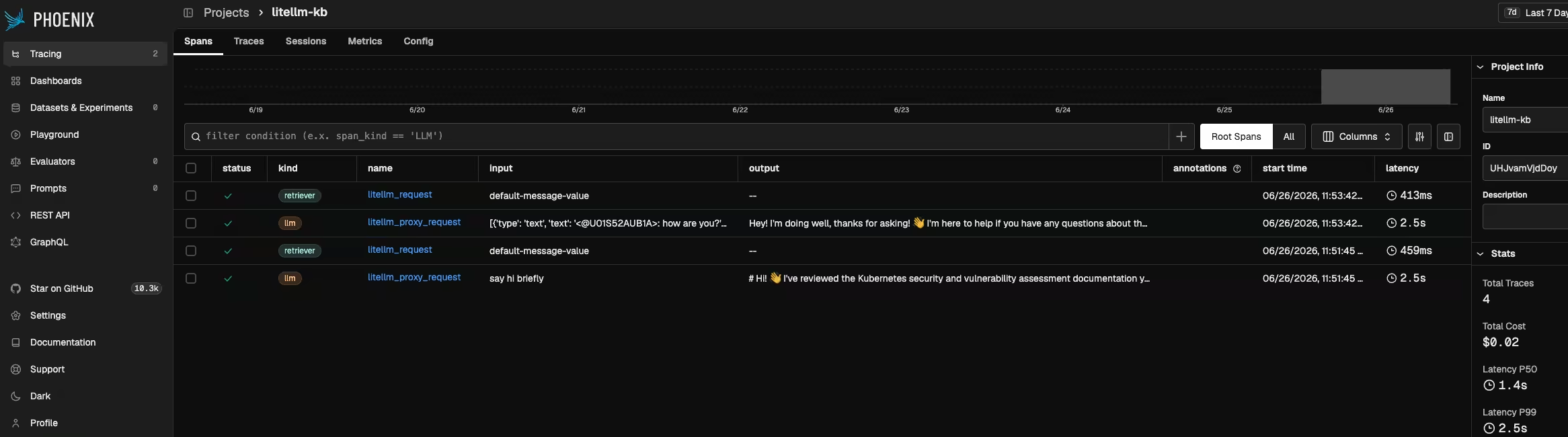
Then open https://phoenix.${CLUSTER_FQDN} in a browser. After the Google OIDC flow (the same SSO as the chat UI) you land in Arize Phoenix; under the litellm-kb project you will see one trace per question, each with spans for the Knowledge Base Retrieve step and the Bedrock completion - latency, token usage, and the full prompt/response captured by the arize_phoenix callback.
 Arize Phoenix
Clean-up
Collmbo, the dedicated litellm-kb release, Arize Phoenix, the Knowledge Base, the OpenSearch Serverless collection and the Confluence secret all live inside the base cluster’s OpenTofu state, so the standard clean-up from Amazon EKS with Open WebUI and AWS Bedrock managed by OpenTofu removes them together with the rest of the cluster - there is nothing extra to delete.

The full teardown (tofu destroy, S3 state removal, Karpenter EC2 cleanup, …) is performed by the base post’s clean-up steps, which recreate both OpenTofu files and destroy the whole working directory at once:
1
2
3
4
5
6
export TF_VAR_slack_app_token="anything"
export TF_VAR_slack_bot_token="anything"
export TF_VAR_confluence_url="https://example.atlassian.net"
export TF_VAR_confluence_username="anything"
export TF_VAR_confluence_api_token="anything"
export TF_VAR_confluence_space_key="DOCS"
Enjoy … 😉