Amazon Bedrock AgentCore Slack Bot deployed with OpenTofu
Deploy a Slack bot powered by Amazon Bedrock AgentCore with Context7 MCP tools using OpenTofu

This post was inspired by Integrating Amazon Bedrock AgentCore with Slack and many screenshots are reused from that repository.
It walks through deploying a Slack bot powered by Amazon Bedrock AgentCore using OpenTofu. The bot integrates Context7 MCP tools for real-time documentation and code example lookups, enabling your team to query programming libraries directly from Slack.
The architecture uses a fully serverless approach: API Gateway (REST API) receives Slack webhooks, Lambda functions handle verification and processing, and the AgentCore Runtime runs the AI agent with Claude Haiku 4.5 as the foundation model. Security is handled via WAF v2 (AWS Managed Rules Common + Known Bad Inputs + rate limiting), KMS encryption, Bedrock Guardrails (PII filtering + content moderation), and Slack signature verification.
flowchart TD
  User(["Slack User"])

  User -- "message / @mention" --> Slack
  Slack -- "POST webhook" --> WAF
  WAF -- "allowed" --> APIGW
  APIGW -- "POST /slack-events" --> LV
  LV -- "get credentials" --> SSM
  SSM -. "decrypt" .-> KMS
  LV -- "async invoke" --> LP
  LP -- "invoke runtime" --> RT
  RT -- "Converse API" --> BR
  BR --> Guard
  RT -- "MCP tools/list + tools/call" --> GW
  GW -- "tools" --> C7

  subgraph AWS["AWS us-east-1"]
    WAF["WAF v2"]
    KMS["KMS CMK"]
    APIGW["API Gateway (REST API)"]
    SSM["SSM Parameter Store\n(Slack credentials)"]
    subgraph Lambda["Lambda"]
      LV["Verification"]
      LP["Processing"]
    end
    subgraph AgentCore["Bedrock AgentCore"]
      RT["Runtime"]
      GW["Gateway"]
    end
    BR["Bedrock\n(Claude Haiku 4.5)"]
    Guard["Guardrail\n(PII + content)"]
  end

  Slack["Slack"]
  C7["Context7\nMCP Server"]

  style Lambda fill:#b45f06,stroke:#ed7100
  style AgentCore fill:#0b5394,stroke:#8c4fff
The request flow:
- A user sends a message in Slack (direct message or
@mentionin a channel). - Slack sends a webhook POST request which passes through WAF v2 — requests matching AWS Managed Rules (Common Rule Set, Known Bad Inputs) are blocked, and IPs exceeding 2000 requests per 5 minutes are rate-limited.
- The REST API Gateway routes
POST /slack-eventsto the Verification Lambda via AWS_PROXY integration. - The Verification Lambda retrieves Slack credentials from SSM Parameter Store and validates the request signature using HMAC-SHA256.
- After verification, it async-invokes the Processing Lambda and returns
200immediately (meeting Slack’s 3-second timeout). - The Processing Lambda invokes the AgentCore Runtime with the user’s query and a session ID derived from the thread timestamp.
- The Runtime discovers tools from the MCP Gateway (Context7) and runs a tool-use loop with the Bedrock Converse API.
- The Bedrock Guardrail enforces content filtering and PII protection.
- The response is converted to Slack’s
mrkdwnformat and posted to the thread.
Requirements
You will need to configure the AWS CLI and set up other necessary secrets and variables:
1
2
3
4
# AWS Credentials
export AWS_ACCESS_KEY_ID="xxxxxxxxxxxxxxxxxx"
export AWS_SECRET_ACCESS_KEY="xxxxxxxxxxxxxxxxxxxxxxxxxxxxxxxxxxxxxx"
export AWS_SESSION_TOKEN="xxxxxxxx"
Set the required environment variables:
1
2
3
4
5
6
7
8
9
# AWS Region
export AWS_REGION="${AWS_REGION:-us-east-1}"
# Project name used for resource naming
export PROJECT_NAME="${PROJECT_NAME:-slack-agentcore}"
# OpenTofu variables
export TF_VAR_tags="{\"Owner\":\"${MY_EMAIL:-petr.ruzicka@gmail.com}\",\"Environment\":\"dev\",\"Managed-by\":\"opentofu\"}"
# Working directory
export TMP_DIR="${TMP_DIR:-${PWD}/tmp}"
mkdir -pv "${TMP_DIR}/${PROJECT_NAME}"
Install the required tools:
1
mise use opentofu@1.12.1 aws@2.35.2 uv@0.11.21 node@24.11.1
Create a Slack App
Before deploying infrastructure, you need to create a Slack app and obtain the Bot Token and Signing Secret.
- Go to Slack API and choose Create New App.
 Slack API - Create New App
- Choose From scratch.
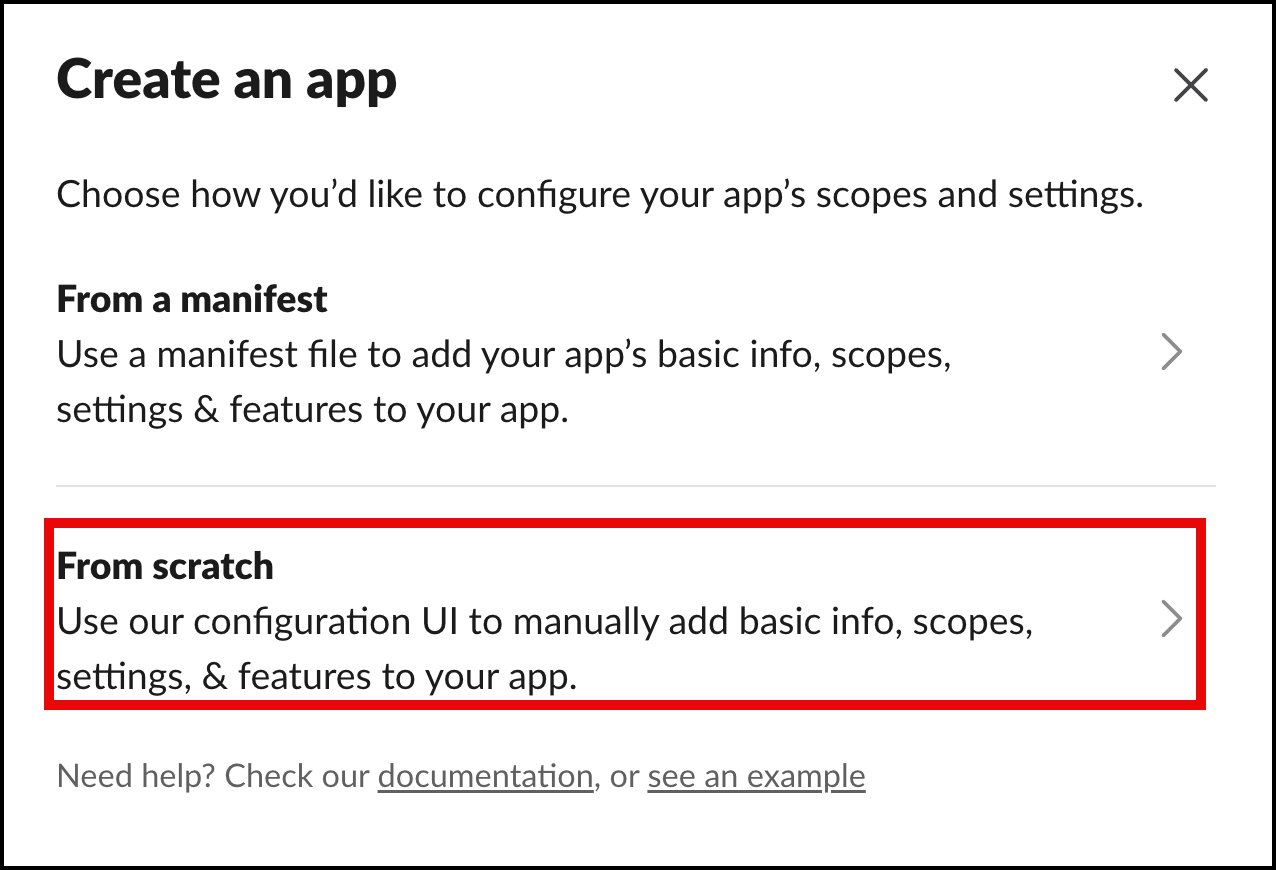 Create an app - From scratch
- Enter the App Name (
Slack Bot) and pick the workspace. - Choose Create App.
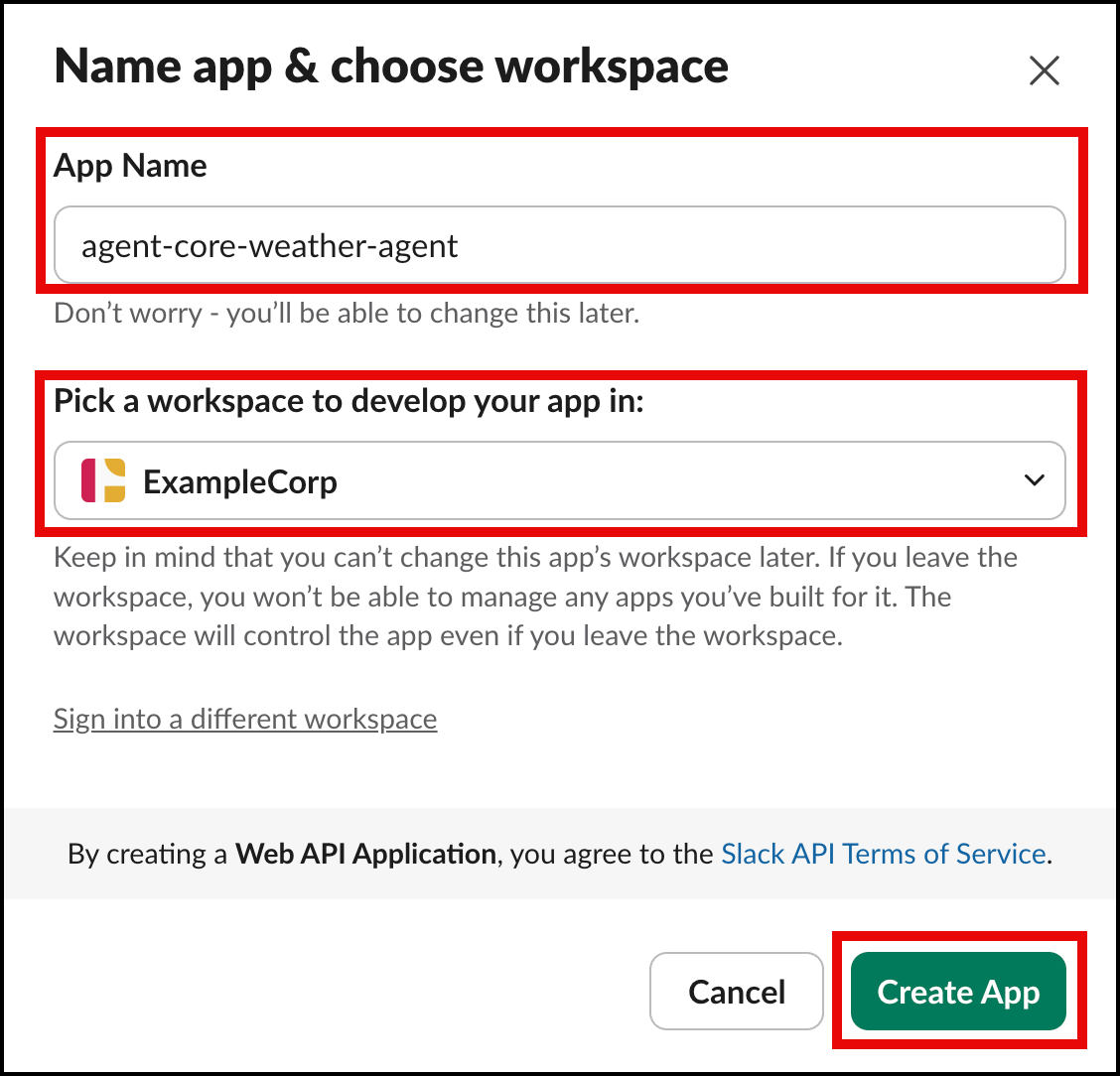 Name app and choose workspace
Configure OAuth & Permissions
- Navigate to Features > OAuth & Permissions.
- Under Bot Token Scopes, add the following scopes:
app_mentions:read(receive events when the bot is @mentioned)chat:write(send messages as the bot)im:history(view messages in direct message conversations)im:read(view basic information about direct messages)im:write(start direct messages with users)
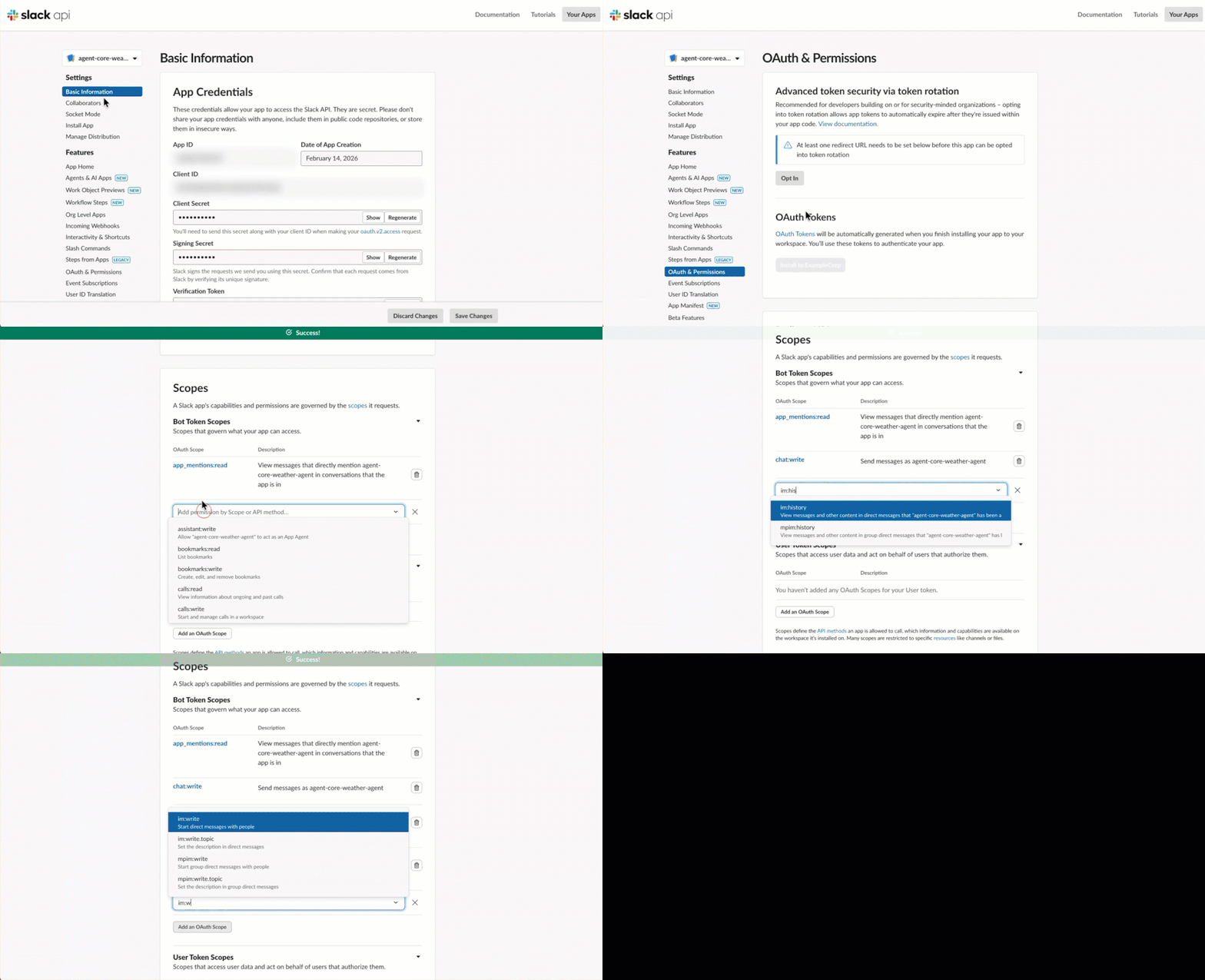 Adding Bot Token Scopes
- Install the app to your workspace.
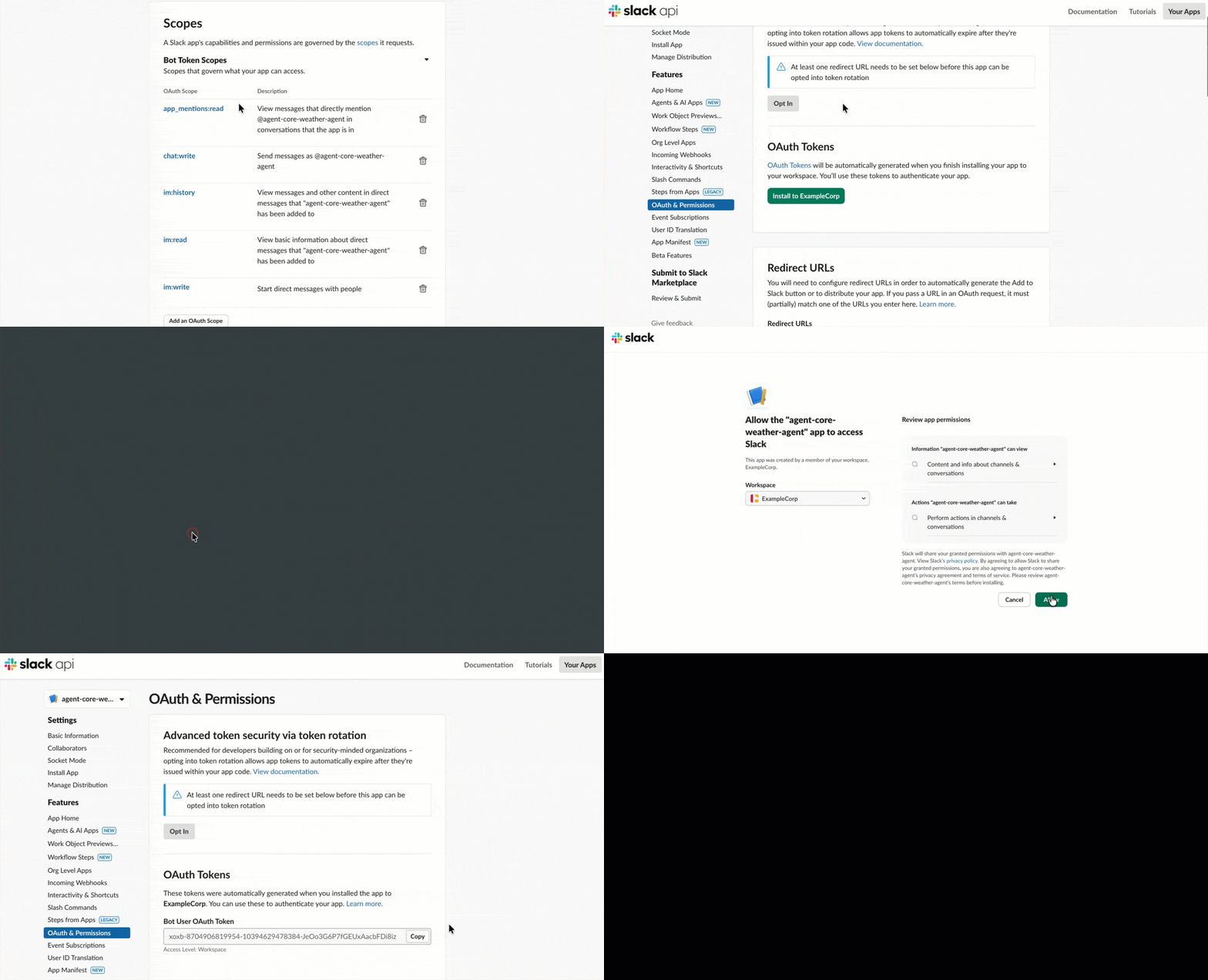 Installing the app to the workspace
- Copy the Bot User OAuth Token (
xoxb-...) - you will need this later.
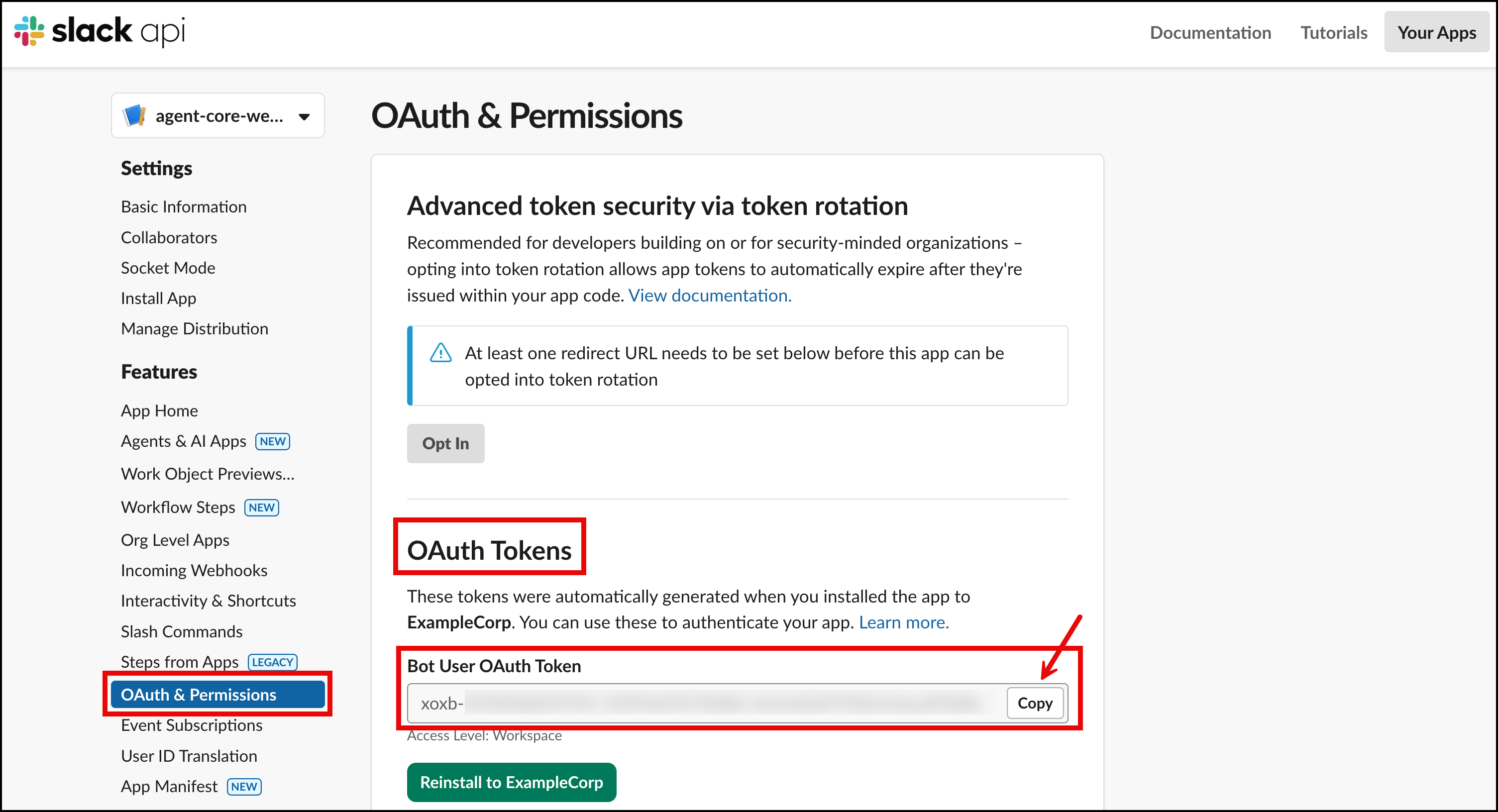 Copy the Bot User OAuth Token
Get the Signing Secret
- Navigate to Settings > Basic Information.
- Under Signing Secret, choose Show and copy the value.
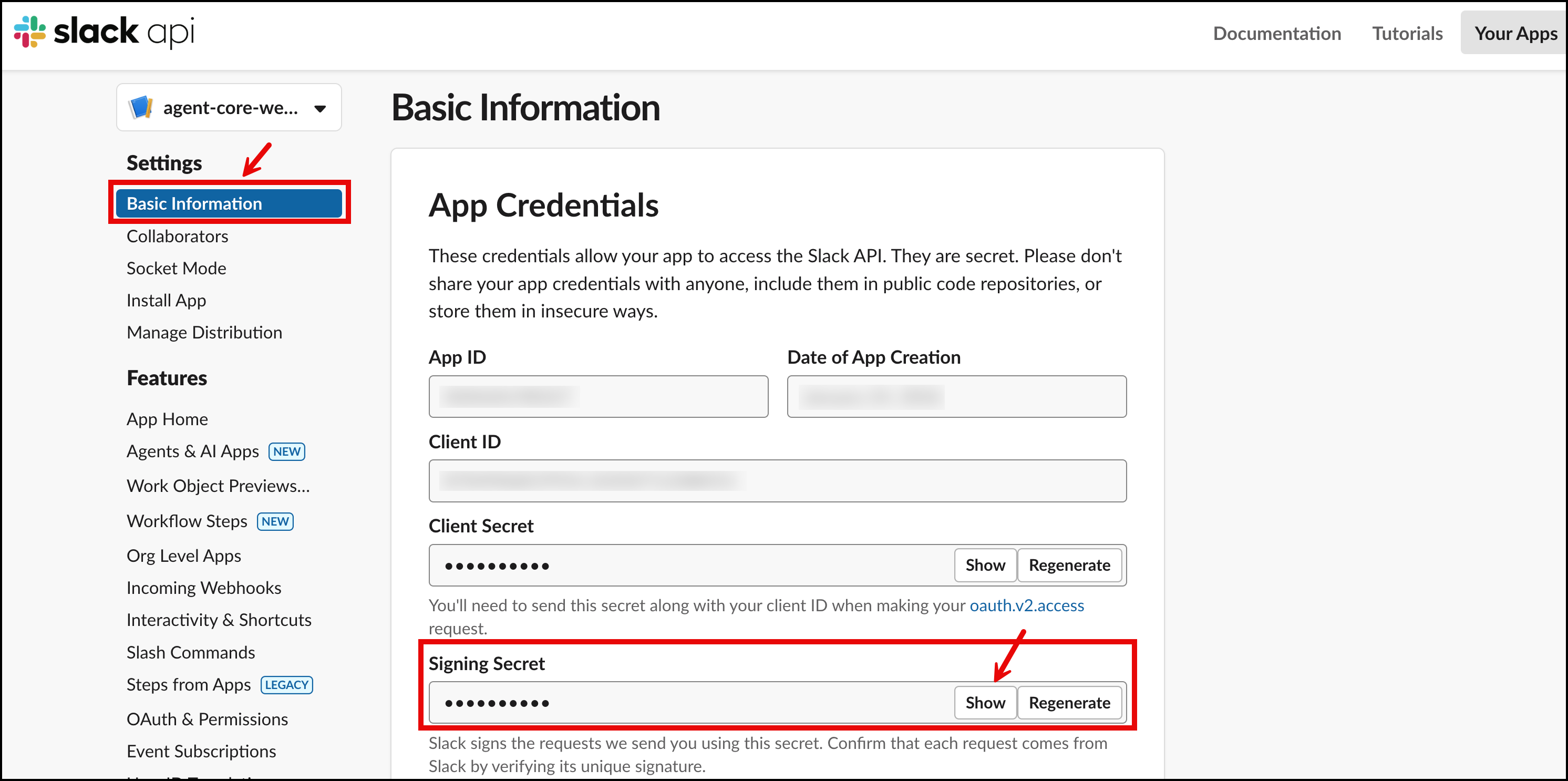 Copy the Signing Secret
Enable Direct Messages
- Navigate to Features > App Home.
- Enable Allow users to send Slash commands and messages from the messages tab.
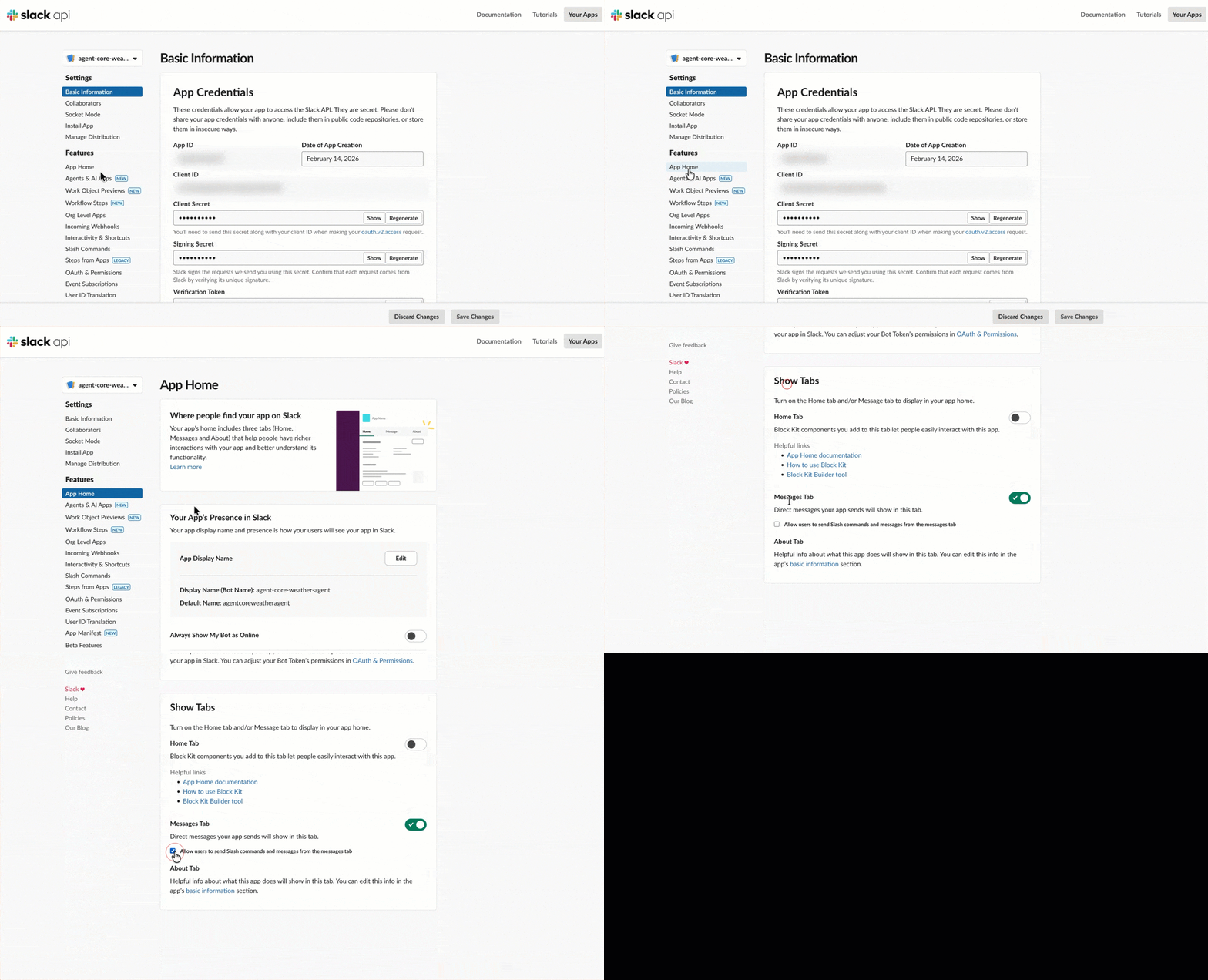 Enable direct messaging
Set the Slack credentials obtained above as OpenTofu variables:
1
2
export TF_VAR_slack_bot_token="${MY_SLACK_BOT_TOKEN}"
export TF_VAR_slack_signing_secret="${MY_SLACK_BOT_SIGNING_SECRET}"
Create S3 bucket for Tofu state
Create an S3 bucket to store OpenTofu remote state using CloudFormation. The bucket uses KMS encryption, lifecycle policies, and blocks all public access:
1
2
3
4
5
6
7
8
9
10
11
12
13
14
15
16
17
18
19
20
21
22
23
24
25
26
27
28
29
30
31
32
33
34
35
36
37
38
39
40
41
42
43
44
45
46
47
48
49
50
51
52
53
54
55
56
57
if [[ ! ${MY_TASK:-} =~ delete: ]] && ! aws s3api head-bucket --bucket "${PROJECT_NAME}" 2> /dev/null; then
  cat > "${TMP_DIR}/${PROJECT_NAME}/s3.yaml" << \EOF
AWSTemplateFormatVersion: "2010-09-09"
Description: S3 bucket for OpenTofu state files
Parameters:
  Name:
    Description: Name of the S3 bucket
    Type: String
Resources:
  S3Bucket:
    Type: AWS::S3::Bucket
    Properties:
      BucketName: !Ref Name
      PublicAccessBlockConfiguration:
        BlockPublicAcls: true
        BlockPublicPolicy: true
        IgnorePublicAcls: true
        RestrictPublicBuckets: true
      LifecycleConfiguration:
        Rules:
          - Id: MultipartUploadLifecycleRule
            Status: Enabled
            AbortIncompleteMultipartUpload:
              DaysAfterInitiation: 1
      BucketEncryption:
        ServerSideEncryptionConfiguration:
          - ServerSideEncryptionByDefault:
              SSEAlgorithm: aws:kms
              KMSMasterKeyID: alias/aws/s3
  S3BucketPolicy:
    Type: AWS::S3::BucketPolicy
    Properties:
      Bucket: !Ref S3Bucket
      PolicyDocument:
        Version: "2012-10-17"
        Statement:
          - Sid: ForceSSLOnlyAccess
            Effect: Deny
            Principal: "*"
            Action: s3:*
            Resource:
              - !GetAtt S3Bucket.Arn
              - !Sub ${S3Bucket.Arn}/*
            Condition:
              Bool:
                aws:SecureTransport: "false"
Outputs:
  S3Bucket:
    Value: !Ref S3Bucket
EOF

  aws cloudformation deploy --region "${AWS_REGION}" \
    --stack-name "${PROJECT_NAME}-s3" \
    --tags "Owner=${MY_EMAIL:-petr.ruzicka@gmail.com}" "Environment=dev" \
    --parameter-overrides "Name=${PROJECT_NAME}" \
    --template-file "${TMP_DIR}/${PROJECT_NAME}/s3.yaml"
fi
Deploy the infrastructure with OpenTofu

The OpenTofu configuration deploys the following components:
- KMS CMK - encrypts SSM parameters and CloudWatch log groups
- SSM Parameter Store - stores Slack credentials as SecureString
- Lambda (Verification) - verifies Slack webhook signatures
- Lambda (Processing) - invokes AgentCore and updates Slack messages
- API Gateway (REST API) - single
POST /slack-eventsroute with Lambda proxy integration - WAF v2 - protects API Gateway with AWS Managed Rules + rate limiting
- S3 Bucket - reuses the state bucket for the agent runtime zip
- Bedrock AgentCore Gateway - MCP protocol gateway connecting to Context7
- Bedrock Guardrail - content filtering + PII protection
- Bedrock AgentCore Runtime - Python runtime with tool-use loop
Main OpenTofu configuration
Write the main OpenTofu configuration with provider setup, locals, and data sources:
1
2
3
4
5
6
7
8
9
10
11
12
13
14
15
16
17
18
19
20
21
22
23
24
25
26
27
28
29
30
31
32
33
34
35
36
37
38
39
40
41
42
43
44
45
46
47
48
49
50
cat > "${TMP_DIR}/${PROJECT_NAME}/main.tf" << EOF
terraform {
  required_version = ">= 1.12"

  backend "s3" {
    bucket       = "${PROJECT_NAME}"
    key          = "terraform.tfstate"
    use_lockfile = true
  }

  required_providers {
    aws = {
      source  = "hashicorp/aws"
      # renovate: datasource=terraform-provider depName=hashicorp/aws
      version = "6.49.0"
    }
  }
}

provider "aws" {
  region = var.aws_region

  default_tags {
    tags = var.tags
  }
}

locals {
  lambda_runtime = "nodejs24.x"

  pii_block = [
    "PASSWORD", "CREDIT_DEBIT_CARD_NUMBER", "PIN",
    "INTERNATIONAL_BANK_ACCOUNT_NUMBER", "SWIFT_CODE",
    "AWS_ACCESS_KEY", "AWS_SECRET_KEY",
    "US_SOCIAL_SECURITY_NUMBER", "US_INDIVIDUAL_TAX_IDENTIFICATION_NUMBER",
    "US_BANK_ACCOUNT_NUMBER", "US_BANK_ROUTING_NUMBER",
    "CA_HEALTH_NUMBER", "CA_SOCIAL_INSURANCE_NUMBER",
    "UK_UNIQUE_TAXPAYER_REFERENCE_NUMBER", "UK_NATIONAL_INSURANCE_NUMBER",
    "UK_NATIONAL_HEALTH_SERVICE_NUMBER",
  ]

  pii_anonymize = [
    "PHONE", "EMAIL", "ADDRESS", "DRIVER_ID", "LICENSE_PLATE",
    "VEHICLE_IDENTIFICATION_NUMBER", "MAC_ADDRESS",
  ]
}

data "aws_caller_identity" "current" {}
data "aws_region" "current" {}
EOF
OpenTofu variables
Write the OpenTofu variables file:
1
2
3
4
5
6
7
8
9
10
11
12
13
14
15
16
17
18
19
20
21
22
23
24
25
26
27
28
29
30
31
32
33
34
35
36
cat > "${TMP_DIR}/${PROJECT_NAME}/variables.tf" << \EOF
variable "aws_region" {
  description = "AWS region for deployment"
  type        = string
  default     = "us-east-1"
}

variable "project_name" {
  description = "Project name used for resource naming"
  type        = string
  default     = "slack-agentcore"
}

variable "slack_bot_token" {
  description = "Slack Bot User OAuth Token (xoxb-...)"
  type        = string
  sensitive   = true
}

variable "slack_signing_secret" {
  description = "Slack app signing secret for webhook verification"
  type        = string
  sensitive   = true
}

variable "foundation_model" {
  description = "Bedrock foundation model ID for the agent"
  type        = string
  default     = "us.anthropic.claude-haiku-4-5-20251001-v1:0"
}

variable "tags" {
  description = "Tags applied to all AWS resources"
  type        = map(string)
}
EOF
Infrastructure resources
Write the infrastructure resources (KMS, SSM, Lambda, API Gateway, WAF, S3, AgentCore):
1
2
3
4
5
6
7
8
9
10
11
12
13
14
15
16
17
18
19
20
21
22
23
24
25
26
27
28
29
30
31
32
33
34
35
36
37
38
39
40
41
42
43
44
45
46
47
48
49
50
51
52
53
54
55
56
57
58
59
60
61
62
63
64
65
66
67
68
69
70
71
72
73
74
75
76
77
78
79
80
81
82
83
84
85
86
87
88
89
90
91
92
93
94
95
96
97
98
99
100
101
102
103
104
105
106
107
108
109
110
111
112
113
114
115
116
117
118
119
120
121
122
123
124
125
126
127
128
129
130
131
132
133
134
135
136
137
138
139
140
141
142
143
144
145
146
147
148
149
150
151
152
153
154
155
156
157
158
159
160
161
162
163
164
165
166
167
168
169
170
171
172
173
174
175
176
177
178
179
180
181
182
183
184
185
186
187
188
189
190
191
192
193
194
195
196
197
198
199
200
201
202
203
204
205
206
207
208
209
210
211
212
213
214
215
216
217
218
219
220
221
222
223
224
225
226
227
228
229
230
231
232
233
234
235
236
237
238
239
240
241
242
243
244
245
246
247
248
249
250
251
252
253
254
255
256
257
258
259
260
261
262
263
264
265
266
267
268
269
270
271
272
273
274
275
276
277
278
279
280
281
282
283
284
285
286
287
288
289
290
291
292
293
294
295
296
297
298
299
300
301
302
303
304
305
306
307
308
309
310
311
312
313
314
315
316
317
318
319
320
321
322
323
324
325
326
327
328
329
330
331
332
333
334
335
336
337
338
339
340
341
342
343
344
345
346
347
348
349
350
351
352
353
354
355
356
357
358
359
360
361
362
363
364
365
366
367
368
369
370
371
372
373
374
375
376
377
378
379
380
381
382
383
384
385
386
387
388
389
390
391
392
393
394
395
396
397
398
399
400
401
402
403
404
405
406
407
408
409
410
411
412
413
414
415
416
417
418
419
420
421
422
423
424
425
426
427
428
429
430
431
432
433
434
435
436
437
438
439
440
441
442
443
444
445
446
447
448
449
450
451
452
453
454
455
456
457
458
459
460
461
462
463
464
465
466
467
468
469
470
471
472
473
474
475
476
477
478
479
480
481
482
483
484
485
486
487
488
489
490
491
492
493
494
495
496
497
498
499
500
501
502
503
504
505
506
507
508
509
510
511
512
513
514
515
516
517
518
519
520
521
522
523
524
525
526
527
528
529
530
531
532
533
534
535
536
537
538
539
540
541
542
543
544
545
546
547
548
549
550
551
552
553
554
555
556
557
558
559
560
561
562
563
564
565
566
567
568
569
570
571
572
573
574
575
576
577
578
579
580
cat > "${TMP_DIR}/${PROJECT_NAME}/infrastructure.tf" << \EOF
# -----------------------------------------------------------------------------
# KMS CMK - encrypts SSM SecureString parameters and CloudWatch log groups
# -----------------------------------------------------------------------------

module "kms" {
  source  = "terraform-aws-modules/kms/aws"
  # renovate: datasource=terraform-module depName=terraform-aws-modules/kms/aws
  version = "4.2.0"

  description             = "KMS key for ${var.project_name}"
  deletion_window_in_days = 7
  aliases                 = [var.project_name]

  key_statements = [
    {
      sid        = "AllowCloudWatchLogs"
      principals = [{ type = "Service", identifiers = ["logs.${data.aws_region.current.region}.amazonaws.com"] }]
      actions = [
        "kms:Encrypt*", "kms:Decrypt*", "kms:ReEncrypt*",
        "kms:GenerateDataKey*", "kms:Describe*",
      ]
      resources = ["*"]
      condition = [{
        test     = "ArnLike"
        variable = "kms:EncryptionContext:aws:logs:arn"
        values   = ["arn:aws:logs:${data.aws_region.current.region}:${data.aws_caller_identity.current.account_id}:*"]
      }]
    },
  ]
}

# -----------------------------------------------------------------------------
# SSM Parameter Store - Slack credentials
# -----------------------------------------------------------------------------

resource "aws_ssm_parameter" "slack_bot_token" {
  name        = "/${var.project_name}/slack/bot-token"
  description = "Slack Bot User OAuth Token"
  type        = "SecureString"
  key_id      = module.kms.key_arn
  value       = var.slack_bot_token
}

resource "aws_ssm_parameter" "slack_signing_secret" {
  name        = "/${var.project_name}/slack/signing-secret"
  description = "Slack app signing secret"
  type        = "SecureString"
  key_id      = module.kms.key_arn
  value       = var.slack_signing_secret
}

# -----------------------------------------------------------------------------
# Lambda - Verification (reads Slack secrets from SSM, verifies signature)
# -----------------------------------------------------------------------------

module "lambda_verification" {
  source  = "terraform-aws-modules/lambda/aws"
  # renovate: datasource=terraform-module depName=terraform-aws-modules/lambda/aws
  version = "8.8.0"

  function_name = "${var.project_name}-verification"
  description   = "Verifies Slack webhook signatures using SSM Parameter Store"
  handler       = "index.handler"
  runtime       = local.lambda_runtime
  publish       = true
  timeout       = 10

  cloudwatch_logs_retention_in_days = 1
  cloudwatch_logs_kms_key_id        = module.kms.key_arn

  source_path = "${path.module}/lambda/verification"

  environment_variables = {
    SLACK_BOT_TOKEN_PARAM      = aws_ssm_parameter.slack_bot_token.name
    SLACK_SIGNING_SECRET_PARAM = aws_ssm_parameter.slack_signing_secret.name
    PROCESSING_FUNCTION        = module.lambda_processing.lambda_function_name
    LOG_LEVEL                  = "INFO"
  }

  attach_policy_statements = true
  policy_statements = {
    ssm_read = {
      effect = "Allow"
      actions = [
        "ssm:GetParameter",
        "ssm:GetParameters",
      ]
      resources = [
        aws_ssm_parameter.slack_bot_token.arn,
        aws_ssm_parameter.slack_signing_secret.arn,
      ]
    }
    kms_decrypt = {
      effect    = "Allow"
      actions   = ["kms:Decrypt"]
      resources = [module.kms.key_arn]
    }
    lambda_invoke = {
      effect    = "Allow"
      actions   = ["lambda:InvokeFunction"]
      resources = [module.lambda_processing.lambda_function_arn]
    }
  }

  allowed_triggers = {
    api_gateway = {
      service    = "apigateway"
      source_arn = "${module.api_gateway.execution_arn}/*/*"
    }
  }
}

# -----------------------------------------------------------------------------
# Lambda - Processing (invokes AgentCore, posts answer to Slack)
# -----------------------------------------------------------------------------

module "lambda_processing" {
  source  = "terraform-aws-modules/lambda/aws"
  # renovate: datasource=terraform-module depName=terraform-aws-modules/lambda/aws
  version = "8.8.0"

  function_name = "${var.project_name}-processing"
  description   = "Processes Slack events: posts status, invokes AgentCore Runtime, updates Slack"
  handler       = "index.handler"
  runtime       = local.lambda_runtime
  publish       = true
  timeout       = 300
  memory_size   = 256

  cloudwatch_logs_retention_in_days = 1
  cloudwatch_logs_kms_key_id        = module.kms.key_arn

  source_path = [
    {
      path             = "${path.module}/lambda/processing"
      npm_requirements = true
    }
  ]

  environment_variables = {
    AGENT_CORE_RUNTIME_ARN = aws_bedrockagentcore_agent_runtime.main.agent_runtime_arn
    LOG_LEVEL              = "INFO"
  }

  attach_policy_statements = true
  policy_statements = {
    agentcore_invoke = {
      effect  = "Allow"
      actions = ["bedrock-agentcore:InvokeAgentRuntime"]
      resources = [
        aws_bedrockagentcore_agent_runtime.main.agent_runtime_arn,
        "${aws_bedrockagentcore_agent_runtime.main.agent_runtime_arn}/runtime-endpoint/*",
      ]
    }
  }

  # Async invocation config (no DLQ - relies on Lambda auto-retries + CloudWatch)
  create_async_event_config    = true
  maximum_retry_attempts       = 2
  maximum_event_age_in_seconds = 3600
}

# -----------------------------------------------------------------------------
# CloudWatch Log Groups + API Gateway Account Settings
# -----------------------------------------------------------------------------

# Pre-create log groups to control retention and encryption
locals {
  cloudwatch_log_groups = {
    api_gateway_welcome = {
      name       = "/aws/apigateway/welcome"
      kms_key_id = module.kms.key_arn
    }
    agentcore_runtime = {
      name       = "/aws/bedrock-agentcore/runtimes/${var.project_name}"
      kms_key_id = module.kms.key_arn
    }
    waf = {
      name       = "aws-waf-logs-${var.project_name}"
      kms_key_id = module.kms.key_arn
    }
  }
}

resource "aws_cloudwatch_log_group" "this" {
  for_each          = local.cloudwatch_log_groups
  name              = each.value.name
  retention_in_days = 1
  kms_key_id        = each.value.kms_key_id
}

module "api_gateway_account_settings" {
  depends_on = [aws_cloudwatch_log_group.this["api_gateway_welcome"]]

  source  = "cloudposse/api-gateway/aws//modules/account-settings"
  # renovate: datasource=terraform-module depName=cloudposse/api-gateway/aws
  version = "0.9.0"
  name      = "${var.project_name}-apigw"
}

# -----------------------------------------------------------------------------
# API Gateway (REST API v1) - uses cloudposse module with OpenAPI spec
# -----------------------------------------------------------------------------

module "api_gateway" {
  depends_on = [module.api_gateway_account_settings]

  source  = "cloudposse/api-gateway/aws"
  # renovate: datasource=terraform-module depName=cloudposse/api-gateway/aws
  version = "0.9.0"
  name       = var.project_name
  stage_name = "v1"

  openapi_config = {
    openapi = "3.0.1"
    info = {
      title   = "${var.project_name}-api"
      version = "1.0"
    }
    paths = {
      "/slack-events" = {
        post = {
          x-amazon-apigateway-integration = {
            httpMethod = "POST"
            type       = "AWS_PROXY"
            uri        = "arn:aws:apigateway:${data.aws_region.current.region}:lambda:path/2015-03-31/functions/${module.lambda_verification.lambda_function_arn}/invocations"
          }
        }
      }
    }
  }
}

# Kept separate: name depends on module.api_gateway.id (would cause cycle in for_each)
resource "aws_cloudwatch_log_group" "api_gateway" {
  name              = "API-Gateway-Execution-Logs_${module.api_gateway.id}/v1"
  retention_in_days = 1
  kms_key_id        = module.kms.key_arn
}

# -----------------------------------------------------------------------------
# WAF v2 - Protects API Gateway with AWS Managed Rules + rate limiting
# -----------------------------------------------------------------------------

module "wafv2" {
  source  = "terraform-aws-modules/wafv2/aws"
  # renovate: datasource=terraform-module depName=terraform-aws-modules/wafv2/aws
  version = "2.1.0"
  name        = "${var.project_name}-waf"
  description = "WAF Web ACL protecting Slack webhook API Gateway"

  association_resource_arns = {
    api_gateway = module.api_gateway.stage_arn
  }

  create_logging_configuration    = true
  logging_log_destination_configs = [aws_cloudwatch_log_group.this["waf"].arn]

  rules = {
    aws-managed-common = {
      priority        = 1
      override_action = "none"

      statement = {
        managed_rule_group_statement = {
          name        = "AWSManagedRulesCommonRuleSet"
          vendor_name = "AWS"
        }
      }
    }

    aws-managed-known-bad-inputs = {
      priority        = 2
      override_action = "none"

      statement = {
        managed_rule_group_statement = {
          name        = "AWSManagedRulesKnownBadInputsRuleSet"
          vendor_name = "AWS"
        }
      }
    }

    # Block any single IP exceeding 2000 requests in a 5-minute window
    # (2000 is the minimum allowed value for rate_based_statement limit)
    rate-limit = {
      priority = 3
      action   = "block"

      statement = {
        rate_based_statement = {
          limit = 2000
        }
      }
    }
  }
}

# -----------------------------------------------------------------------------
# S3 - Build the Agent Runtime package and upload it to the state bucket
# -----------------------------------------------------------------------------

data "aws_s3_bucket" "main" {
  bucket = var.project_name
}

resource "terraform_data" "agent_runtime_build" {
  triggers_replace = [
    filemd5("${path.module}/agent-runtime/agent_runtime.py"),
    filemd5("${path.module}/agent-runtime/requirements.txt"),
  ]

  provisioner "local-exec" {
    command     = <<-EOT
      set -e
      rm -rf .build/agent-runtime-package
      mkdir -p .build/agent-runtime-package
      uv pip install \
        --python-platform aarch64-manylinux2014 \
        --python-version 3.12 \
        --target .build/agent-runtime-package \
        --only-binary=:all: \
        -r agent-runtime/requirements.txt
      cp agent-runtime/agent_runtime.py .build/agent-runtime-package/
      cd .build/agent-runtime-package && zip -rq ../agent-runtime.zip . -x "*.pyc" -x "*__pycache__*" -x "*/sboms/*"
    EOT
    working_dir = path.module
  }
}

resource "aws_s3_object" "agent_runtime_code" {
  depends_on = [terraform_data.agent_runtime_build]

  bucket      = data.aws_s3_bucket.main.id
  key         = "agent-runtime/agent-runtime.zip"
  source      = "${path.module}/.build/agent-runtime.zip"
  source_hash = sha256("${filesha256("${path.module}/agent-runtime/agent_runtime.py")}${filesha256("${path.module}/agent-runtime/requirements.txt")}")
}

# -----------------------------------------------------------------------------
# Bedrock AgentCore - Gateway (connects to Context7 MCP server)
# -----------------------------------------------------------------------------

resource "aws_iam_role" "agentcore_gateway" {
  name = "${var.project_name}-agentcore-gateway"

  assume_role_policy = jsonencode({
    Version = "2012-10-17"
    Statement = [{
      Effect = "Allow"
      Action = "sts:AssumeRole"
      Principal = {
        Service = "bedrock-agentcore.amazonaws.com"
      }
      Condition = {
        StringEquals = {
          "aws:SourceAccount" = data.aws_caller_identity.current.account_id
        }
      }
    }]
  })
}

resource "aws_bedrockagentcore_gateway" "main" {
  name            = "${var.project_name}-gateway"
  description     = "MCP Gateway for Context7 documentation tools"
  role_arn        = aws_iam_role.agentcore_gateway.arn
  authorizer_type = "AWS_IAM"
  protocol_type   = "MCP"

  protocol_configuration {
    mcp {
      instructions       = "Gateway providing access to Context7 MCP documentation and code example tools"
      search_type        = "SEMANTIC"
      supported_versions = ["2025-03-26"]
    }
  }
}

resource "aws_bedrockagentcore_gateway_target" "context7" {
  name               = "context7-mcp-target"
  gateway_identifier = aws_bedrockagentcore_gateway.main.gateway_id
  description        = "Context7 MCP server for documentation and code examples"

  target_configuration {
    mcp {
      mcp_server {
        endpoint = "https://mcp.context7.com/mcp"
      }
    }
  }
}

# -----------------------------------------------------------------------------
# Bedrock Guardrail (AI safety + PII protection)
# -----------------------------------------------------------------------------

resource "aws_bedrock_guardrail" "main" {
  name                      = "${var.project_name}-ai-safety"
  description               = "Guardrail for AI model safety and PII compliance"
  blocked_input_messaging   = "Input contains blocked content"
  blocked_outputs_messaging = "Output contains blocked content"

  content_policy_config {
    filters_config {
      type            = "SEXUAL"
      input_strength  = "HIGH"
      output_strength = "HIGH"
    }
    filters_config {
      type            = "PROMPT_ATTACK"
      input_strength  = "HIGH"
      output_strength = "NONE"
    }
  }

  sensitive_information_policy_config {
    dynamic "pii_entities_config" {
      for_each = local.pii_block
      content {
        type   = pii_entities_config.value
        action = "BLOCK"
      }
    }
    dynamic "pii_entities_config" {
      for_each = local.pii_anonymize
      content {
        type   = pii_entities_config.value
        action = "ANONYMIZE"
      }
    }
  }
}

# -----------------------------------------------------------------------------
# Bedrock AgentCore - Runtime
# -----------------------------------------------------------------------------

resource "aws_iam_role" "agentcore_runtime" {
  name = "${var.project_name}-agentcore-runtime"

  assume_role_policy = jsonencode({
    Version = "2012-10-17"
    Statement = [{
      Effect = "Allow"
      Action = "sts:AssumeRole"
      Principal = {
        Service = "bedrock-agentcore.amazonaws.com"
      }
      Condition = {
        StringEquals = {
          "aws:SourceAccount" = data.aws_caller_identity.current.account_id
        }
      }
    }]
  })
}

data "aws_iam_policy_document" "agentcore_runtime" {
  statement {
    sid    = "BedrockInvokeModel"
    effect = "Allow"
    actions = [
      "bedrock:InvokeModel",
      "bedrock:InvokeModelWithResponseStream",
      "bedrock:Converse",
      "bedrock:ConverseStream",
    ]
    # Cross-region inference profiles dispatch to bare-id foundation-model ARNs, so allow both shapes
    resources = [
      "arn:aws:bedrock:*::foundation-model/${replace(var.foundation_model, "/^(us|eu|apac)\\./", "")}",
      "arn:aws:bedrock:*:${data.aws_caller_identity.current.account_id}:inference-profile/${var.foundation_model}",
    ]
    condition {
      test     = "StringEquals"
      variable = "bedrock:GuardrailIdentifier"
      values   = [aws_bedrock_guardrail.main.guardrail_arn]
    }
  }

  statement {
    sid       = "BedrockApplyGuardrail"
    effect    = "Allow"
    actions   = ["bedrock:ApplyGuardrail"]
    resources = [aws_bedrock_guardrail.main.guardrail_arn]
  }

  statement {
    sid       = "InvokeGateway"
    effect    = "Allow"
    actions   = ["bedrock-agentcore:InvokeGateway"]
    resources = [aws_bedrockagentcore_gateway.main.gateway_arn]
  }

  statement {
    sid    = "CloudWatchLogs"
    effect = "Allow"
    actions = [
      "logs:CreateLogGroup",
      "logs:CreateLogStream",
      "logs:PutLogEvents",
    ]
    resources = ["arn:aws:logs:${data.aws_region.current.region}:${data.aws_caller_identity.current.account_id}:log-group:/aws/bedrock-agentcore/runtimes/${var.project_name}*"]
  }

  statement {
    sid    = "S3ReadAgentCode"
    effect = "Allow"
    actions = [
      "s3:GetObject",
      "s3:GetObjectVersion",
    ]
    resources = ["${data.aws_s3_bucket.main.arn}/*"]
  }

  statement {
    sid       = "S3ListAgentCodeBucket"
    effect    = "Allow"
    actions   = ["s3:ListBucket"]
    resources = [data.aws_s3_bucket.main.arn]
  }

  # Workload identity tokens scoped to this runtime; GetWorkloadAccessTokenForUserId omitted (unverified caller-supplied user IDs)
  statement {
    sid    = "AgentCoreWorkloadIdentity"
    effect = "Allow"
    actions = [
      "bedrock-agentcore:GetWorkloadAccessToken",
      "bedrock-agentcore:GetWorkloadAccessTokenForJWT",
    ]
    resources = [
      "arn:aws:bedrock-agentcore:${data.aws_region.current.region}:${data.aws_caller_identity.current.account_id}:workload-identity-directory/default",
      "arn:aws:bedrock-agentcore:${data.aws_region.current.region}:${data.aws_caller_identity.current.account_id}:workload-identity-directory/default/workload-identity/${replace("${var.project_name}_runtime", "-", "_")}-*",
    ]
  }
}

resource "aws_iam_role_policy" "agentcore_runtime" {
  name   = "agentcore-runtime-policy"
  role   = aws_iam_role.agentcore_runtime.id
  policy = data.aws_iam_policy_document.agentcore_runtime.json
}

resource "aws_bedrockagentcore_agent_runtime" "main" {
  agent_runtime_name = replace("${var.project_name}_runtime", "-", "_")
  description        = "Slack-integrated agent using Context7 MCP tools"
  role_arn           = aws_iam_role.agentcore_runtime.arn

  agent_runtime_artifact {
    code_configuration {
      runtime     = "PYTHON_3_12"
      entry_point = ["agent_runtime.py"]

      code {
        s3 {
          bucket = data.aws_s3_bucket.main.id
          prefix = aws_s3_object.agent_runtime_code.key
        }
      }
    }
  }

  network_configuration {
    network_mode = "PUBLIC"
  }

  protocol_configuration {
    server_protocol = "HTTP"
  }

  environment_variables = {
    GATEWAY_ARN       = aws_bedrockagentcore_gateway.main.gateway_arn
    MODEL_ID          = var.foundation_model
    AWS_REGION        = data.aws_region.current.region
    GUARDRAIL_ID      = aws_bedrock_guardrail.main.guardrail_arn
    GUARDRAIL_VERSION = "DRAFT"
  }
}
EOF
OpenTofu outputs
1
2
3
4
5
6
cat > "${TMP_DIR}/${PROJECT_NAME}/outputs.tf" << \EOF
output "webhook_url" {
  description = "Slack webhook URL to configure in Event Subscriptions"
  value       = "${module.api_gateway.invoke_url}/slack-events"
}
EOF
Lambda - Verification function
The Verification Lambda handles Slack URL verification challenges, validates webhook signatures using HMAC-SHA256 with timing-safe comparison, and async-invokes the Processing Lambda to meet Slack’s 3-second response timeout:
1
2
3
4
5
6
7
8
9
10
11
12
13
14
15
16
17
18
19
20
21
22
23
24
25
26
27
28
29
30
31
32
33
34
35
36
37
38
39
40
41
42
43
44
45
46
47
48
49
50
51
52
53
54
55
56
57
58
59
60
61
62
63
64
65
66
67
68
69
70
71
72
73
74
75
76
77
78
79
80
81
82
83
84
85
86
mkdir -p "${TMP_DIR}/${PROJECT_NAME}/lambda/verification"
cat > "${TMP_DIR}/${PROJECT_NAME}/lambda/verification/index.mjs" << \EOF
import { SSMClient, GetParameterCommand } from "@aws-sdk/client-ssm";
import { LambdaClient, InvokeCommand } from "@aws-sdk/client-lambda";
import { createHmac, timingSafeEqual } from "crypto";

const ssm = new SSMClient();
const lambda = new LambdaClient();
const LOG_LEVEL = process.env.LOG_LEVEL || "INFO";
const log = {
  debug: (msg) => LOG_LEVEL === "DEBUG" && console.log("🔍 [DEBUG]", msg),
  info: (msg) => ["DEBUG", "INFO"].includes(LOG_LEVEL) && console.log("ℹ️ [INFO]", msg),
  error: (msg) => console.error("❌ [ERROR]", msg),
};

// Cache SSM parameters across warm invocations
let cached = null;

async function getCredentials() {
  if (!cached) {
    log.info("🔑 Fetching credentials from SSM Parameter Store");
    const [token, secret] = await Promise.all([
      ssm.send(new GetParameterCommand({ Name: process.env.SLACK_BOT_TOKEN_PARAM, WithDecryption: true })),
      ssm.send(new GetParameterCommand({ Name: process.env.SLACK_SIGNING_SECRET_PARAM, WithDecryption: true })),
    ]);
    cached = { token: token.Parameter.Value, signingSecret: secret.Parameter.Value };
  }
  return cached;
}

function verifySignature(body, timestamp, signature, secret) {
  const computed = `v0=${createHmac("sha256", secret).update(`v0:${timestamp}:${body}`).digest("hex")}`;
  const a = Buffer.from(signature);
  const b = Buffer.from(computed);
  // timingSafeEqual throws on length mismatch - guard so a forged signature returns 403, not 500
  return a.length === b.length && timingSafeEqual(a, b);
}

export async function handler(event) {
  log.debug(`Event: ${JSON.stringify(event)}`);

  try {
    const headers = event.headers || {};
    const body = event.body;
    const rawBody = typeof body === "string" ? body : JSON.stringify(body);

    // Validate signature headers (reject stale requests to block replays)
    const sig = headers["X-Slack-Signature"] || headers["x-slack-signature"];
    const ts = headers["X-Slack-Request-Timestamp"] || headers["x-slack-request-timestamp"];
    if (!sig || !ts || Math.abs(Date.now() / 1000 - parseInt(ts)) > 300) {
      return { statusCode: 403, body: '{"error":"Invalid request"}' };
    }

    // Verify Slack signature before acting on the payload - Slack signs the
    // url_verification handshake too, so authenticate first, then respond.
    const creds = await getCredentials();
    if (!verifySignature(rawBody, ts, sig, creds.signingSecret)) {
      log.info("🚫 Signature verification failed");
      return { statusCode: 403, body: '{"error":"Invalid signature"}' };
    }

    const parsed = typeof body === "string" ? JSON.parse(body) : body;

    // Slack URL verification challenge
    if (parsed.type === "url_verification") {
      log.info("🤝 URL verification challenge");
      return { statusCode: 200, headers: { "Content-Type": "application/json" }, body: JSON.stringify({ challenge: parsed.challenge }) };
    }

    // Async invoke processing Lambda
    log.info("✅ Signature verified, invoking processing Lambda");
    await lambda.send(new InvokeCommand({
      FunctionName: process.env.PROCESSING_FUNCTION,
      InvocationType: "Event",
      Payload: JSON.stringify({ ...event, slackBotToken: creds.token }),
    }));

    return { statusCode: 200, body: '{"message":"OK"}' };
  } catch (error) {
    log.error(`💥 Error: ${error?.message || error}`);
    // Log details above but return a generic body - never echo internal error text (AWS SDK/SSM/KMS) back to the webhook caller.
    const statusCode = `${error?.message || ""}`.includes("signature") ? 403 : 500;
    return { statusCode, body: statusCode === 403 ? '{"error":"Invalid signature"}' : '{"error":"Internal server error"}' };
  }
}
EOF
Lambda - Processing function
The Processing Lambda filters bot messages, invokes the AgentCore Runtime, and converts the markdown response to Slack’s mrkdwn format before posting it to the thread:
1
2
3
4
5
6
7
8
9
10
11
12
mkdir -p "${TMP_DIR}/${PROJECT_NAME}/lambda/processing"
cat > "${TMP_DIR}/${PROJECT_NAME}/lambda/processing/package.json" << \EOF
{
  "name": "processing",
  "version": "1.0.0",
  "type": "module",
  "dependencies": {
    "@aws-sdk/client-bedrock-agentcore": "^3.901.0",
    "markdown-to-slack-mrkdwn": "^1.1.2"
  }
}
EOF
Then write the handler that drives the AgentCore Runtime and updates Slack:
1
2
3
4
5
6
7
8
9
10
11
12
13
14
15
16
17
18
19
20
21
22
23
24
25
26
27
28
29
30
31
32
33
34
35
36
37
38
39
40
41
42
43
44
45
46
47
48
49
50
51
52
53
54
55
56
57
58
59
60
61
62
63
64
65
66
67
68
69
70
71
72
73
74
75
76
77
78
79
80
81
82
83
84
85
86
87
88
89
90
91
92
93
94
95
96
97
98
99
100
101
102
103
104
105
106
107
108
109
110
111
112
113
114
115
116
117
118
119
120
121
122
123
124
125
126
127
128
129
130
131
132
133
134
cat > "${TMP_DIR}/${PROJECT_NAME}/lambda/processing/index.mjs" << \EOF
import {
  BedrockAgentCoreClient,
  InvokeAgentRuntimeCommand,
} from "@aws-sdk/client-bedrock-agentcore";
import https from "https";
import { markdownToSlack, splitForSlack } from "markdown-to-slack-mrkdwn";

const client = new BedrockAgentCoreClient();
const LOG_LEVEL = process.env.LOG_LEVEL || "INFO";
const log = {
  debug: (msg) => LOG_LEVEL === "DEBUG" && console.log("🔍 [DEBUG]", msg),
  info: (msg) => ["DEBUG", "INFO"].includes(LOG_LEVEL) && console.log("ℹ️ [INFO]", msg),
  error: (msg) => console.error("❌ [ERROR]", msg),
};

function callSlack(url, token, data) {
  return new Promise((resolve, reject) => {
    const req = https.request(url, {
      method: "POST",
      headers: { Authorization: `Bearer ${token}`, "Content-Type": "application/json" },
    }, (res) => {
      let d = "";
      res.on("data", (c) => (d += c));
      res.on("end", () => { try { resolve(JSON.parse(d)); } catch { resolve(d); } });
    });
    req.on("error", reject);
    req.write(JSON.stringify(data));
    req.end();
  });
}

async function invokeAgentCore(runtimeArn, prompt, sessionId) {
  const payload = JSON.stringify({ prompt, sessionId, userId: sessionId });
  const cmd = new InvokeAgentRuntimeCommand({
    agentRuntimeArn: runtimeArn,
    runtimeSessionId: sessionId,
    accept: "application/json, text/event-stream",
    contentType: "application/json",
    payload: Buffer.from(payload),
  });

  const response = await client.send(cmd);
  const chunks = [];
  for await (const chunk of response.response) chunks.push(chunk);
  const raw = Buffer.concat(chunks).toString("utf-8");

  log.debug(`Raw response: ${raw.substring(0, 500)}`);

  // Parse based on content type
  if (response.contentType === "application/json") {
    const data = JSON.parse(raw);
    if (data.response) return data.response;
    if (data.message?.content) return data.message.content.filter((i) => i.text).map((i) => i.text).join("\n");
    return data.message || JSON.stringify(data);
  }

  // SSE or plain text
  if (raw.includes("data: ")) {
    return raw.split("\n").filter((l) => l.startsWith("data: ")).map((l) => l.slice(6).trim()).join("");
  }
  return raw;
}

export async function handler(event) {
  log.debug(`Event: ${JSON.stringify(event)}`);

  try {
    const body = typeof event.body === "string" ? JSON.parse(event.body) : event.body;

    if (body.type !== "event_callback" || !body.event) {
      return { statusCode: 200, body: '{"message":"OK"}' };
    }

    const e = body.event;

    // Filter: ignore bots, non-user, non-relevant events
    if (e.bot_id || e.subtype === "bot_message" || e.subtype === "message_changed") {
      log.info("🤖 Ignoring bot message");
      return { statusCode: 200, body: '{"message":"ignored"}' };
    }
    if (!(e.type === "app_mention" || (e.type === "message" && e.channel_type === "im"))) {
      return { statusCode: 200, body: '{"message":"OK"}' };
    }
    if (!e.user) return { statusCode: 200, body: '{"message":"no user"}' };

    const slackBotToken = event.slackBotToken;
    const threadTs = e.thread_ts || e.ts;

    // Build session ID from thread timestamp
    const sessionId = `slack-thread-${threadTs}`.replace(/\./g, "_").padEnd(33, "0");
    const userMessage = (e.text || "").replace(/<@[A-Z0-9]+>/g, "").trim();

    if (!userMessage) {
      await callSlack("https://slack.com/api/chat.postMessage", slackBotToken, {
        channel: e.channel, text: "🤷 I received an empty message. Please try again.", thread_ts: threadTs,
      });
      return { statusCode: 200, body: '{"message":"empty"}' };
    }

    // Invoke AgentCore and get response
    log.info(`🚀 Invoking AgentCore for session: ${sessionId}`);
    let completion;
    try {
      completion = await invokeAgentCore(process.env.AGENT_CORE_RUNTIME_ARN, userMessage, sessionId);
    } catch (err) {
      log.error(`🔥 AgentCore error: ${err.name} ${err.message}`);
      completion = "⚠️ I'm experiencing technical difficulties. Please try again later.";
    }

    // Strip model thinking tags and convert to Slack format
    completion = completion
      .replace(/<thinking>[\s\S]*?<\/thinking>/gi, "")
      .replace(/<response>([\s\S]*?)<\/response>/gi, "$1")
      .trim() || "🫥 I received your message but got an empty response.";

    const slackText = markdownToSlack(completion);

    // Post the answer as a single message (split into thread replies if long)
    const chunks = splitForSlack(slackText, { maxLength: 3500 });
    log.info(`✏️ Posting answer (${chunks.length} chunk(s))`);
    for (const chunk of chunks) {
      await callSlack("https://slack.com/api/chat.postMessage", slackBotToken, {
        channel: e.channel, text: chunk, thread_ts: threadTs,
      });
    }

    return { statusCode: 200, body: '{"message":"OK"}' };
  } catch (error) {
    log.error(`💥 Processing error: ${error.message}`);
    throw error;
  }
}
EOF
Agent Runtime (Python)
The AgentCore Runtime is a Python application that runs on Bedrock AgentCore. It uses SigV4-signed requests to communicate with the MCP Gateway, discovers tools, and runs a tool-use loop with the Bedrock Converse API:
1
2
3
4
5
6
mkdir -p "${TMP_DIR}/${PROJECT_NAME}/agent-runtime"
cat > "${TMP_DIR}/${PROJECT_NAME}/agent-runtime/requirements.txt" << \EOF
boto3==1.43.27
bedrock-agentcore>=1.0.0
urllib3>=2.0.0
EOF
1
2
3
4
5
6
7
8
9
10
11
12
13
14
15
16
17
18
19
20
21
22
23
24
25
26
27
28
29
30
31
32
33
34
35
36
37
38
39
40
41
42
43
44
45
46
47
48
49
50
51
52
53
54
55
56
57
58
59
60
61
62
63
64
65
66
67
68
69
70
71
72
73
74
75
76
77
78
79
80
81
82
83
84
85
86
87
88
89
90
91
92
93
94
95
96
97
98
99
100
101
102
103
104
105
106
107
108
109
110
111
112
113
114
115
116
117
118
119
120
121
122
123
124
125
126
127
128
129
130
131
132
133
134
135
136
137
138
139
140
141
142
143
144
145
146
147
148
149
150
151
152
153
154
155
156
157
158
159
160
161
162
163
164
165
166
167
168
169
170
171
172
173
174
175
176
177
178
179
180
181
182
183
184
185
186
187
188
189
190
191
192
193
194
195
196
197
198
199
200
201
202
203
204
205
206
207
208
209
210
211
cat > "${TMP_DIR}/${PROJECT_NAME}/agent-runtime/agent_runtime.py" << \EOF
"""
Agent Runtime for Slack integration with Bedrock AgentCore.

Uses BedrockAgentCoreApp runtime from bedrock-agentcore SDK:
1. Receives prompts via /invocations (handled by @app.entrypoint)
2. Calls AgentCore Gateway (Context7 MCP) for tool discovery and execution
3. Uses Bedrock Converse API with tool-use loop for multi-step reasoning
4. Returns final response
"""

import json
import logging
import os

import boto3
from botocore.auth import SigV4Auth
from botocore.awsrequest import AWSRequest
import urllib3

from bedrock_agentcore.runtime import BedrockAgentCoreApp

# Configuration
GATEWAY_ARN = os.environ.get("GATEWAY_ARN", "")
MODEL_ID = os.environ.get("MODEL_ID", "us.anthropic.claude-haiku-4-5-20251001-v1:0")
AWS_REGION = os.environ.get("AWS_REGION", "us-east-1")
GUARDRAIL_ID = os.environ.get("GUARDRAIL_ID", "")
GUARDRAIL_VERSION = os.environ.get("GUARDRAIL_VERSION", "DRAFT")
LOG_LEVEL = os.environ.get("LOG_LEVEL", "INFO")

logging.basicConfig(level=getattr(logging, LOG_LEVEL))
logger = logging.getLogger(__name__)

gateway_id = GATEWAY_ARN.split("/")[-1] if "/" in GATEWAY_ARN else ""
GATEWAY_URL = f"https://{gateway_id}.gateway.bedrock-agentcore.{AWS_REGION}.amazonaws.com/mcp"

SYSTEM_PROMPT = """You are a helpful AI assistant integrated with Slack.
You have access to Context7 documentation and code example tools through your MCP gateway.
Use these tools to provide accurate, up-to-date information about programming libraries,
frameworks, and their documentation.

When answering questions:
- Use the available tools to look up current documentation and code examples
- Provide accurate, well-formatted responses suitable for Slack
- Include code examples when relevant
- Be concise but thorough
- If you cannot find information, say so clearly rather than guessing
"""

bedrock_client = boto3.client("bedrock-runtime", region_name=AWS_REGION)
http = urllib3.PoolManager()

app = BedrockAgentCoreApp()


# ---------------------------------------------------------------------------
# MCP Gateway Client (SigV4-signed JSON-RPC)
# ---------------------------------------------------------------------------

def _mcp_request(method_name, params=None):
    """Send a JSON-RPC request to the MCP Gateway."""
    payload = {"jsonrpc": "2.0", "id": 1, "method": method_name}
    if params:
        payload["params"] = params

    body = json.dumps(payload).encode()
    headers = {"Content-Type": "application/json", "Accept": "application/json, text/event-stream"}

    session = boto3.Session()
    creds = session.get_credentials().get_frozen_credentials()
    aws_req = AWSRequest(method="POST", url=GATEWAY_URL, data=body, headers=headers)
    SigV4Auth(creds, "bedrock-agentcore", AWS_REGION).add_auth(aws_req)
    signed = dict(aws_req.headers)
    signed["Content-Type"] = "application/json"
    signed["Accept"] = "application/json, text/event-stream"

    resp = http.request("POST", GATEWAY_URL, body=body, headers=signed, timeout=30.0)
    if resp.status != 200:
        logger.error("MCP request failed: %d %s", resp.status, resp.data.decode())
        return None

    data = resp.data.decode()
    if data.startswith("data:"):
        for line in data.split("\n"):
            if line.startswith("data:"):
                json_str = line[5:].strip()
                if json_str:
                    return json.loads(json_str)
    else:
        return json.loads(data)
    return None


def get_mcp_tools():
    """Fetch available tools from the MCP Gateway."""
    _mcp_request("initialize", {
        "protocolVersion": "2025-03-26",
        "capabilities": {},
        "clientInfo": {"name": "agentcore-runtime", "version": "1.0.0"},
    })
    _mcp_request("notifications/initialized")
    result = _mcp_request("tools/list")
    if not result or "result" not in result:
        return []
    tools = result["result"].get("tools", [])
    logger.info("Discovered %d MCP tools", len(tools))
    return tools


def call_mcp_tool(tool_name, arguments):
    """Call a tool via the MCP Gateway."""
    result = _mcp_request("tools/call", {"name": tool_name, "arguments": arguments})
    if not result or "result" not in result:
        return {"error": f"Tool call failed: {result}"}
    content = result["result"].get("content", [])
    texts = [c.get("text", "") for c in content if c.get("type") == "text"]
    return {"result": "\n".join(texts)} if texts else {"result": json.dumps(content)}


# ---------------------------------------------------------------------------
# Bedrock Converse with Tool-Use Loop
# ---------------------------------------------------------------------------

def invoke_with_tools(prompt, mcp_tools, max_iterations=5):
    """Run the Bedrock Converse tool-use loop."""
    messages = [{"role": "user", "content": [{"text": prompt}]}]

    tool_config = None
    if mcp_tools:
        tool_configs = [{
            "toolSpec": {
                "name": t["name"],
                "description": t.get("description", ""),
                "inputSchema": {"json": t.get("inputSchema", {"type": "object", "properties": {}})},
            }
        } for t in mcp_tools]
        tool_config = {"tools": tool_configs}

    for _ in range(max_iterations):
        kwargs = {"modelId": MODEL_ID, "messages": messages, "system": [{"text": SYSTEM_PROMPT}]}
        if tool_config:
            kwargs["toolConfig"] = tool_config
        if GUARDRAIL_ID:
            kwargs["guardrailConfig"] = {"guardrailIdentifier": GUARDRAIL_ID, "guardrailVersion": GUARDRAIL_VERSION}

        response = bedrock_client.converse(**kwargs)
        message = response["output"]["message"]
        stop_reason = response.get("stopReason", "")
        messages.append(message)

        if stop_reason == "tool_use":
            tool_results = []
            for block in message.get("content", []):
                if "toolUse" in block:
                    tu = block["toolUse"]
                    logger.info("Calling tool: %s", tu["name"])
                    result = call_mcp_tool(tu["name"], tu.get("input", {}))
                    tool_results.append({
                        "toolResult": {
                            "toolUseId": tu["toolUseId"],
                            "content": [{"text": result.get("result", json.dumps(result))}],
                        }
                    })
            messages.append({"role": "user", "content": tool_results})
            continue

        texts = [b.get("text", "") for b in message.get("content", []) if "text" in b]
        return "\n".join(texts) if texts else "I processed your request but got an empty response."

    return "I reached the maximum number of tool-use iterations. Here's what I have so far."


# ---------------------------------------------------------------------------
# AgentCore Runtime Entrypoint
# ---------------------------------------------------------------------------

@app.entrypoint
def invoke(payload):
    """Main agent entrypoint - handles /invocations."""
    prompt = payload.get("prompt", "")
    logger.info("Invocation - prompt: %s", prompt[:80])

    # Debug mode
    if prompt.strip().lower().startswith("debug:"):
        debug_info = {"gateway_url": GATEWAY_URL, "gateway_arn": GATEWAY_ARN}
        try:
            debug_info["initialize_result"] = _mcp_request("initialize", {
                "protocolVersion": "2025-03-26", "capabilities": {},
                "clientInfo": {"name": "agentcore-runtime", "version": "1.0.0"},
            })
            debug_info["tools_list_result"] = _mcp_request("tools/list")
        except Exception as e:
            debug_info["error"] = str(e)
        return {"response": json.dumps(debug_info, indent=2)}

    # Fetch MCP tools and run tool-use loop
    mcp_tools = []
    if GATEWAY_ARN:
        try:
            mcp_tools = get_mcp_tools()
        except Exception as e:
            logger.warning("Failed to fetch MCP tools: %s", e)

    result = invoke_with_tools(prompt, mcp_tools)

    return {"response": result}


if __name__ == "__main__":
    app.run()
EOF
Deploy with OpenTofu
Initialize and apply the OpenTofu configuration:
1
2
3
4
5
6
if aws s3api head-bucket --bucket "${PROJECT_NAME}" 2> /dev/null; then
  tofu -chdir="${TMP_DIR}/${PROJECT_NAME}" init
  if [[ ! ${MY_TASK:-} =~ delete: ]]; then
    tofu -chdir="${TMP_DIR}/${PROJECT_NAME}" apply -auto-approve
  fi
fi
Configure Slack Event Subscriptions
After obtaining the webhook URL from the OpenTofu output, complete the Slack app configuration.
- Return to Slack API and select your app.
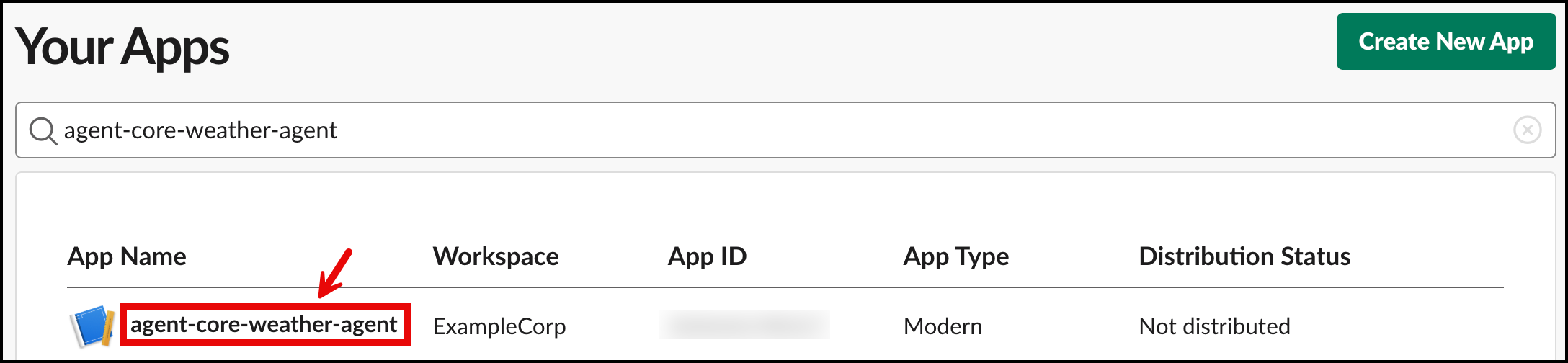 Select your Slack app
- Navigate to Features > Event Subscriptions.
- Toggle Enable Events to On.
- Paste the webhook URL from the OpenTofu
webhook_urloutput into the Request URL field. - After the URL is verified (green checkmark), under Subscribe to bot events add:
app_mention(triggered when the bot is @mentioned in a channel)message.im(direct messages sent to the bot)
- Choose Save Changes.
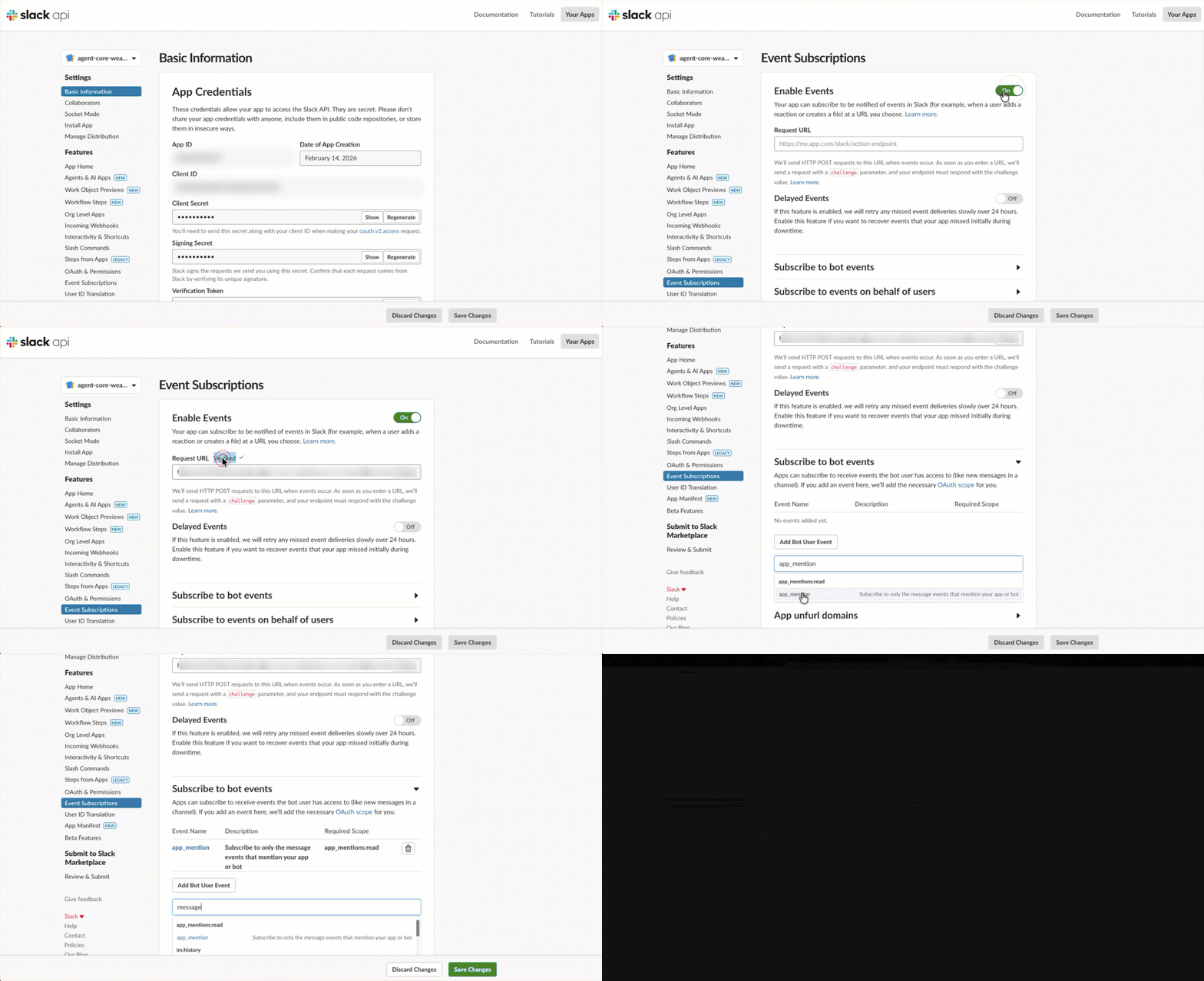 Configure Event Subscriptions with the webhook URL
- Navigate to Settings > Install App and choose Reinstall to apply the new event subscriptions.
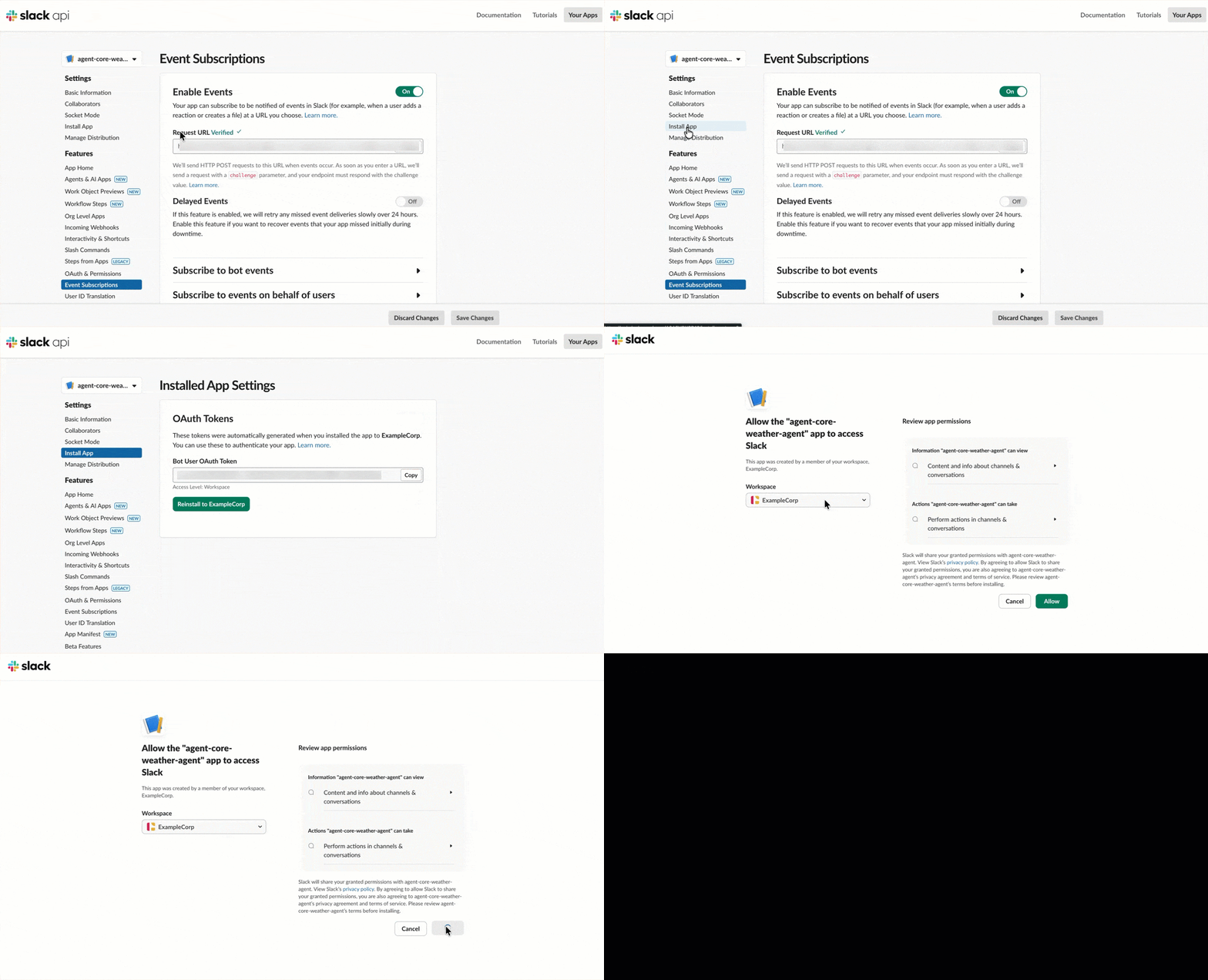 Reinstall the app to activate event subscriptions
Test the integration
Invite the @Slack Bot to a channel and ask it a question:
 Slack Bot Chat test
Architecture details
Session management
Slack organizes conversations into threads identified by timestamps. The solution derives session IDs directly from Slack thread timestamps, ensuring initial messages and replies in a thread share the same AgentCore session. This isolates different threads into separate sessions without external state management.
Asynchronous processing
AgentCore invocations can exceed Slack’s 3-second webhook timeout, especially when the agent performs multiple tool calls. The architecture uses two Lambda functions:
- Verification Lambda - validates the Slack signature and returns HTTP 200 immediately
- Processing Lambda - invokes AgentCore and posts the response to the thread
Security
- KMS CMK encrypts all SSM parameters and CloudWatch logs
- Slack signature verification with HMAC-SHA256 and timing-safe comparison
- Replay protection rejects requests older than 5 minutes
- Bedrock Guardrail enforces content filtering (sexual content, prompt attacks) and PII protection (blocks passwords, credit cards, SSN; anonymizes phone numbers, emails, addresses)
- IAM least-privilege roles for Lambda, AgentCore Runtime, and Gateway
MCP Gateway integration
The AgentCore Gateway provides a standardized interface for tool access with SigV4 authentication. The Runtime uses a custom SigV4-signed HTTP client to communicate with the Gateway, which routes requests to the Context7 MCP server for documentation and code example lookups.
Cleanup
Destroy all resources created by OpenTofu:

Set environment variables:
1
2
3
4
5
6
7
8
9
10
# AWS Region
export AWS_REGION="${AWS_REGION:-us-east-1}"
# Project name used for resource naming
export PROJECT_NAME="${PROJECT_NAME:-slack-agentcore}"
# OpenTofu variables
export TF_VAR_tags="{\"Owner\":\"${MY_EMAIL:-petr.ruzicka@gmail.com}\",\"Environment\":\"dev\",\"Managed-by\":\"opentofu\"}"
export TF_VAR_slack_bot_token="anything"
export TF_VAR_slack_signing_secret="anything"
# Working directory
export TMP_DIR="${TMP_DIR:-${PWD}/tmp}"
Recreate the OpenTofu code files:
1
2
export MY_TASK="${MISE_TASK_NAME}"
mise run "create:${MISE_TASK_NAME##*:}"
1
2
3
4
5
6
if aws s3api head-bucket --bucket "${PROJECT_NAME}" 2> /dev/null; then
  tofu -chdir="${TMP_DIR}/${PROJECT_NAME}" destroy -auto-approve &&
    aws s3 rm "s3://${PROJECT_NAME}" --recursive || true
fi
aws cloudformation delete-stack --stack-name "${PROJECT_NAME}-s3" || true
rm -rf "${TMP_DIR:?}/${PROJECT_NAME:?}" agent-runtime.zip || true